
Reverse Osmosis vs Water Distiller: Which Provides the Purest Drinking Water?
Up until the early 2000’s home-owners had a choice of distillation products to choose from. These were afterall the pioneering products in water treatment and until the advent of the reverse osmosis membrane there was little else to choose from. Today, one would be hard pressed to find a distill for the home, market forces and the efficiencies of RO systems have all but killed off the market for distillation.
Both methods are renowned for their ability to remove a vast spectrum of contaminants that standard jug filters simply cannot address. However, they operate on fundamentally different principles resulting in variations in purity, efficiency, taste, and lifestyle integration. Whilst one relies on an age-old, energy-intensive process, the other represents the pinnacle of modern, precision-engineered purification.
This guide offers a definitive comparison, drawing on over 36 years of British water science innovation to clarify which system truly delivers the purest drinking water for your home and family.
Understanding the Mechanism: How RO and Distillation Differ
At their core, both reverse osmosis and distillation aim to separate pure water molecules from dissolved solids, chemicals, and biological contaminants. Yet, their methods for achieving this are quite different.
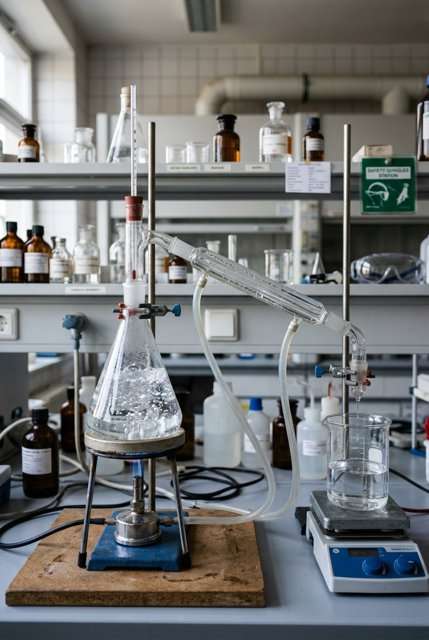
- Water Distillation: This is a thermal process that mimics the earth’s natural water cycle. Water is boiled in a chamber, creating steam (H₂O in its gaseous state) which leaves behind heavier contaminants like salts, minerals, and heavy metals. This steam is then collected and cooled in a separate chamber, where it condenses back into liquid water.
- Reverse Osmosis (RO): This is a sophisticated molecular filtration method. It uses the mains cold water pressure, often aided by a small pump, to force water through a semi-permeable membrane. This process is analogous to water naturally percolating through layers of rock and sand, but with a pore size that is considerably more defined and consistent—a mere 0.0001 microns. This microscopic barrier is fine enough to effectively screen out virtually all ions, allowing only pure water molecules to pass through.
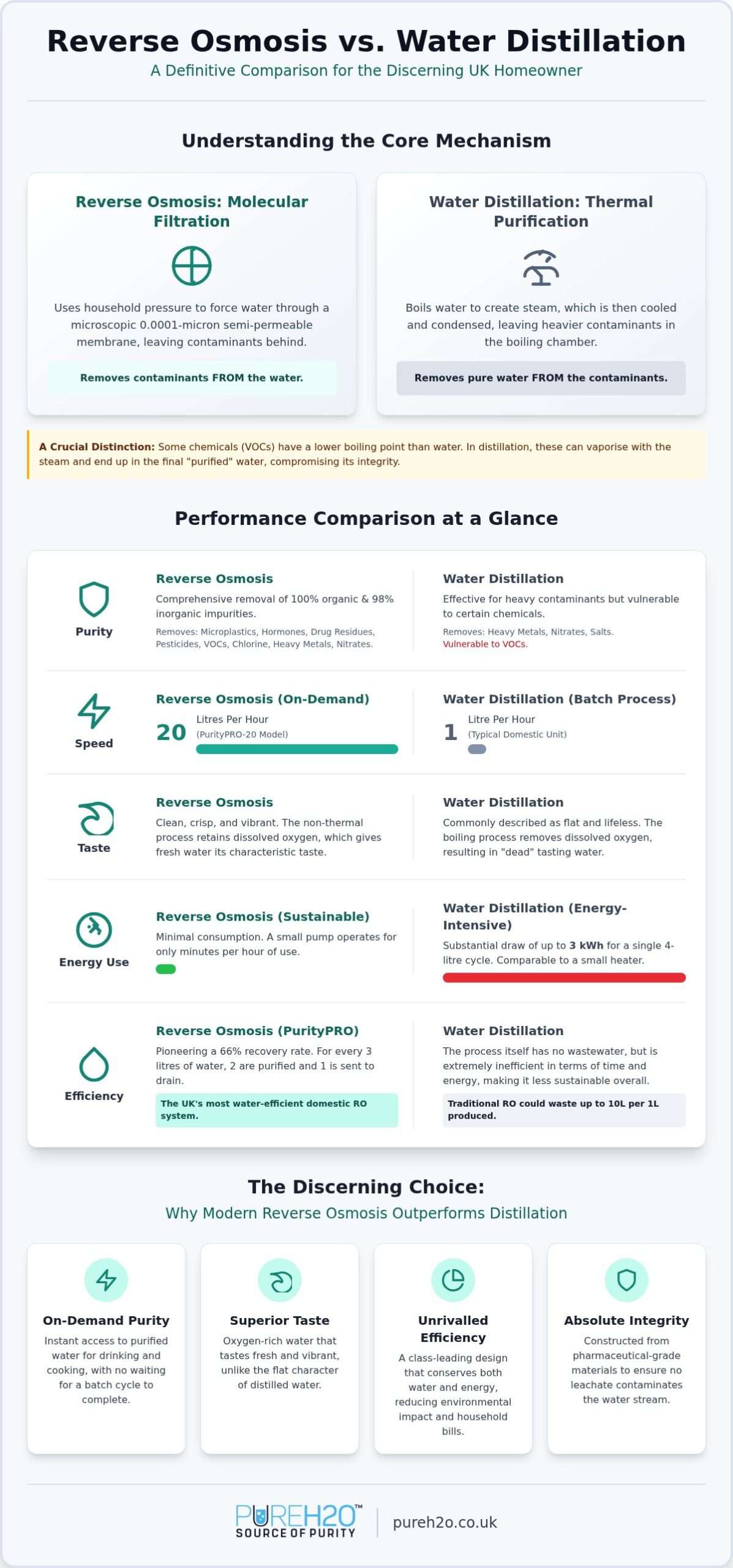
The fundamental difference can be summarised simply: distillation removes pure water from the contaminants, whilst reverse osmosis removes contaminants from the water. This distinction is crucial, particularly when considering volatile organic compounds (VOCs). Because some VOCs have a lower boiling point than water, they can vaporise with the steam and be carried over into the final distilled product, compromising its purity.
The Distillation Process: A Batch-Based Tradition
Water distillation is a batch process, meaning it purifies a set amount of water in a single, time-consuming cycle. A typical countertop distiller requires several hours to heat the water to a rolling boil and maintain it long enough to produce a few litres of purified water. This energy-intensive operation not only contributes to higher electricity bills but also introduces a significant delay. You must wait for the entire cycle to complete before you can access your water, making it impractical for on-demand needs like filling a pan for cooking or quenching immediate thirst.
The RO Method: Precision Engineering for Purity
In contrast, a modern RO system provides pure water on-demand. The key lies in its advanced, multi-stage filtration process, culminating in the RO membrane. The PureH2O PurityPRO system, for instance, is engineered to remove 100% of organic impurities and 98% of inorganic impurities. This includes a comprehensive list of modern concerns, from microplastics and hormones to drug residues and pesticides. Furthermore, our systems are constructed using pharmaceutical-grade materials, ensuring that no leachate from plastics or glues can enter the purified water stream—a guarantee of absolute integrity from start to finish.
Performance Comparison: Purity, Speed, and Efficiency
When evaluating a water purification system, performance must be measured across several key metrics. Whilst both systems are effective, modern RO technology consistently outperforms distillation in the areas that matter most to a contemporary household: contaminant removal specificity, speed, and long-term efficiency.
- Contaminant Removal: Both methods excel at removing heavy metals, nitrates, and salts. However, as mentioned, distillation can struggle with certain VOCs. A high-quality RO system equipped with appropriate carbon pre-filters is superior for removing these and other organic compounds like chlorine, ensuring a more comprehensive purification.
- Production Speed: The difference is stark. A domestic water distiller typically produces around one litre of pure water per hour. The PurityPRO-20, by comparison, can deliver 20 litres per hour on-demand, ready for drinking, cooking, or making crystal-clear ice.
- The "Dead Water" Debate: A common complaint about distilled water is its flat, lifeless taste. This is because the boiling process removes dissolved oxygen, which gives fresh water its crisp character. RO, being a non-thermal process, retains this dissolved oxygen, resulting in water that tastes clean, fresh, and vibrant.
- Recovery Rate: This crucial metric is the ratio of pure water produced to the waste water sent to the drain during the filtration process.
Energy Consumption and Environmental Impact
The environmental credentials of a water purification system are a significant consideration for the eco-conscious homeowner. A standard 4-litre water distiller can consume up to 3 kWh of electricity for a single cycle, a substantial energy draw comparable to running a small heater for several hours. In contrast, the pump on a normal reverse osmosis system can consume between 0.5kW to 1kW per hour
The PurityPRO system from PureH2O in contrast, uses new, low-pressure membrane technology that enables it to process the same if not more water than standard RO systems at a much lower water pressure without a pump. Its clever design with stainless steel break tank means its internal pump, used to deliver purified water to the tap only operates for 2minutes in every 5 litres of water used at the point of use. This minimal energy consumption dramatically reduces the system’s carbon footprint, making reverse osmosis, especially the products made by PureH2O, the far-more sustainable choice for daily use.
Water Efficiency: The PurityPRO Breakthrough
Historically, a primary objection to reverse osmosis was its water wastage. Traditional, outdated RO systems could waste as many as 10 litres of water for every one litre they produced. Recognising this inefficiency, PureH2O pioneered a new standard. Our PurityPRO-10 system achieves an exceptional 66% recovery rate, meaning it produces two litres of pure water for every one litre sent to the drain. This makes it the most water-efficient domestic RO system available in the UK, aligning unparalleled purity with a profound respect for our most precious resource.
The Discerning Choice: Why Modern RO Outperforms Distillation
Beyond the technical specifications, the choice between reverse osmosis and a water distiller comes down to lifestyle, aesthetics, and long-term peace of mind. Here, the advantages of a fully integrated, professionally maintained RO system become undeniable.
In addition to choosing between RO and distillation, it is worth considering the broader investment; for instance, you can explore Smart Water Leak Detection Systems and filtration cost guides to better understand the long-term value of home water upgrades.
- Maintenance Factor: To remain effective, a water distiller’s boiling chamber must be frequently and meticulously descaled. This build-up of limescale and other residues is not only unsightly but can also harbour bacteria if not regularly cleaned, a tedious and ongoing chore. A PureH2O RO system, conversely, is maintained through an annual professional service.
- Lifestyle Integration: A countertop distiller is a bulky appliance that occupies valuable worktop space. A PurityPRO system is discreetly installed under the sink, completely hidden from view. The pure water is dispensed through a dedicated, elegant tap at the sink, preserving the clean lines of a modern British kitchen.
- The Quatreau Smart Tap: For the ultimate in convenience and luxury, our RO systems can be integrated with a Quatreau Smart Tap. This single, sophisticated fixture can deliver 99% pure water that is not only ambient but also boiling, chilled, or sparkling at the touch of a button.
- A Legacy of Excellence: PureH2O is the pinnacle of British engineering, founded on 30 years of pioneering water science. Our systems are not merely filters; they are comprehensive purification solutions designed for those who refuse to compromise on their health or their home’s aesthetic.
Material Purity: The 316L Stainless Steel Standard
A critical factor often overlooked in the water purifier market is the material from which the system is made. Many systems, including both distillers and standard RO units, are housed in plastic. Over time, these plastics can degrade and risk leaching chemicals back into the very water they have just purified. PureH2O rejects this compromise. Our PurityPRO systems feature pharmaceutical-grade 316L stainless steel tanks and pipework, ensuring the purity of your water is protected from the system to your glass.
The PureH2O Service Advantage
Frequently Asked Questions
Is reverse osmosis water the same as distilled water?
Ultimately, water quality comes down to the level of dissolved solids and gases in the final product. Distilled and RO water are virtually the same quality in terms of Total Dissolved Solids (TDS) but there are differences. Whilst both are forms of highly purified water, they are produced by different methods. Distillation boils water to create steam, which can result in a flat taste. Reverse Osmosis uses a membrane to filter water, retaining dissolved oxygen for a fresher, crisper taste. RO is also more effective at removing certain chemical contaminants.
Does reverse osmosis remove fluoride better than distillation?
Boiling water cannot remove fluoride or its compounds found in tap water such as Fluorsilicic acid (H2SiF6) or Sodium Fluoride (NaF). These have a boiling point above 1000C so through distillation its ionic form will remain in the boiler tank.
Sodium fluoride (NaF) has a crystal structure approximately 0.231 nanometer between the sodium cation to the fluoride anion. The PureH2O Reverse Osmosis membrane is rated at 0.0001 microns. to put this in perspective, NaF is therefore 0.0002 microns more than double the size of the membrane pores. It is effectively rejected by the membrane structure.
Both systems are highly effective at removing fluoride, in our calculations, 99%+. The primary difference lies in efficiency and convenience. A reverse osmosis system provides a continuous, on-demand supply of fluoride-free water, making it a more practical solution for daily household use than the slow, batch-based process of distillation. For more information, read our guide on fluoride in UK tap water.
How much electricity does a water distiller use compared to an RO system?
A water distiller is significantly more energy-intensive, requiring a constant power supply to boil water for several hours per cycle. A modern RO system uses a fraction of this energy, with its small booster pump operating only intermittently when the storage tank is being refilled. This makes RO a much more environmentally friendly and cost-effective option.
Which system is easier to maintain for a UK household?
A Reverse Osmosis system with a professional service plan is far easier to maintain. A water distiller requires the owner to perform frequent, manual descaling and cleaning of the boiling chamber. The range of RO systems from PureH2O are designed for minimal user intervention, with a single annual service visit from a trained technician to replace filters and ensure the system is operating at peak performance.
Disclaimer
The content of this article represents the views of the author and 36years practical experience.