
How to Reduce Microplastics in Drinking Water: A 2026 Guide to Absolute Purity
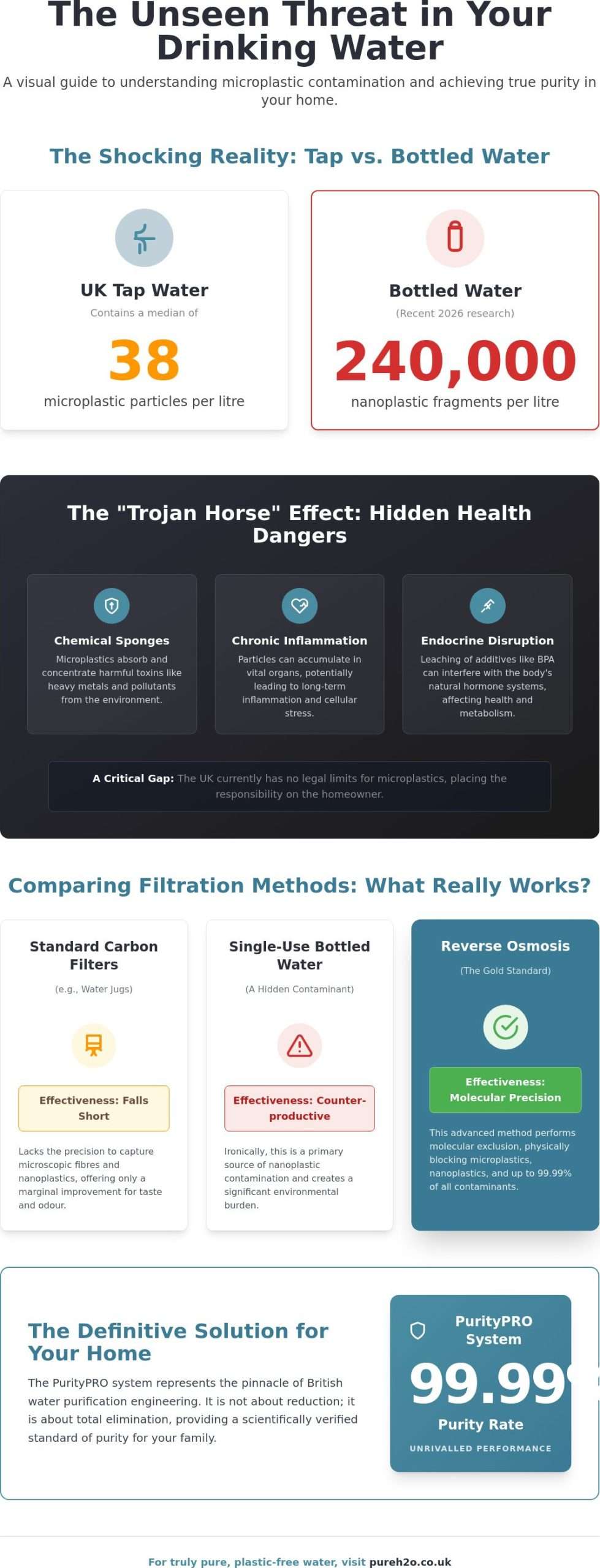
Did you know that whilst UK tap water contains a median of 38 microplastic particles per litre, recent 2026 research indicates bottled water can harbour as many as 240,000 nanoplastic fragments in that same volume? If you’re feeling a sense of unease regarding the water flowing from your kitchen tap, you aren’t alone. With the UK currently lacking legal limits or mandatory monitoring for these contaminants, it’s natural to feel a deep distrust of standard quality. You’re likely searching for a definitive answer on how to reduce microplastics in drinking water without settling for the hidden risks of plastic bottles.
We understand that the conflicting data and technical jargon surrounding filtration can be overwhelming. You deserve a solution that isn’t just a marginal improvement but a bespoke standard of excellence. This guide will reveal the scientific methods required to eliminate microplastic contamination entirely, allowing you to achieve the pinnacle of water purity in your own home. We’ll explore why standard carbon blocks often fall short and how the precision of British-engineered reverse osmosis provides the absolute 99.99% purity rate your health demands.
Key Takeaways
- Understand the hidden prevalence of synthetic polymers in the UK water supply and why current regulatory gaps necessitate a personal, proactive approach to home water security.
- Discover why microplastics act as “Trojan horses” for chemical pollutants and how eliminating these particles can mitigate potential risks of endocrine disruption and inflammation.
- Learn exactly how to reduce microplastics in drinking water by distinguishing between basic carbon filters and the molecular precision of advanced reverse osmosis.
- Transition from the environmental burden of single-use bottled water to a sustainable, high-performance lifestyle powered by bespoke, under-sink purification technology.
- Explore the technical superiority of the PurityPRO system, a hallmark of British engineering that achieves an unrivalled 99.99% purity rate for your home.
Understanding the Microplastic Challenge in UK Drinking Water
Synthetic polymers have permeated our environment to such an extent that they are now a permanent fixture in our water cycle. For those investigating how to reduce microplastics in drinking water, the first step is acknowledging that these particles aren’t merely floating debris; they are complex chemical carriers. A foundational aspect of Understanding the Microplastic Challenge is recognising that these fragments originate from both primary industrial production and the secondary degradation of larger items. As we move through 2026, the British Standards Institution continues to refine its guidance on water quality, yet a definitive legal limit for microplastic concentration remains absent from UK legislation. This regulatory gap leaves the responsibility of purity in the hands of the homeowner.
The 2024 University of Birmingham study, which found microplastics in 100% of tap water samples across 13 UK cities, serves as a stark reminder of our ageing infrastructure’s vulnerability. Whilst standard municipal treatment is designed to manage biological threats, it often fails to intercept the microscopic fibres shed from industrial runoff and degrading PVC pipes. For the discerning individual, simple “reduction” is no longer the gold standard. Achieving absolute purity requires a shift in perspective from basic filtration to high-precision molecular exclusion.
The Distinction Between Microplastics and Nanoplastics
While microplastics are often defined as fragments under 5mm, it’s the smaller nanoplastics that present the most significant concern for human health. Nanoplastics are particles smaller than 1 micrometre that pose the greatest health risk. Because of their infinitesimal size, these particles are capable of crossing biological barriers and entering the human bloodstream directly. Effective removal requires a membrane with a micron rating small enough to intercept these sub-microscopic threats, a feat that standard household jugs simply cannot achieve.
Sources of Contamination in the Domestic Supply
Contamination enters your home through several primary pathways. Atmospheric deposition carries plastic dust into open reservoirs, whilst the breakdown of larger plastic waste in the environment creates a constant influx of secondary microplastics. Crucially, our own domestic infrastructure contributes to the count; as pipes age, they shed synthetic particulates into the flow. Most wastewater treatment plants are currently unequipped to catch the smallest synthetic fibres, meaning these pollutants often recirculate back into the drinking supply, necessitating a robust point-of-use solution to ensure your water is truly plastic-free.
The Health Implications of Chronic Microplastic Ingestion
The ingestion of synthetic polymers is rarely an isolated event. Instead, these particles function as ‘Trojan horses’ within the human body. Because microplastics possess a high surface area-to-volume ratio, they readily absorb hydrophobic toxins, heavy metals, and persistent organic pollutants from the environment before they ever reach your glass. When you consider how to reduce microplastics in drinking water, you are essentially deciding how to shield your cellular health from these concentrated chemical payloads. Over decades, these particles can accumulate within human tissues, particularly the liver and kidneys, leading to a state of chronic low-grade inflammation. Research published in early 2026 has increasingly linked this persistent exposure to the disruption of the delicate gut microbiome, suggesting that the physical presence of plastic is only half the story.
Endocrine Disruption and Chemical Leaching
Microplastics are frequently manufactured with, or coated in, hazardous additives such as Bisphenol A (BPA) and various phthalates. These substances are well-documented endocrine disruptors that mimic or interfere with the body’s natural hormonal signalling. Even at infinitesimal concentrations, these chemicals can impact metabolic health, energy regulation, and reproductive systems. Analysis of Practical Steps to Reduce Plastic Exposure at Home confirms that the leaching process is often accelerated once particles enter the warm, acidic environment of the human digestive tract. This chemical release triggers oxidative stress at a cellular level, as the body’s immune system attempts to neutralise foreign objects it lacks the enzymes to break down.
The Precautionary Principle for Modern Families
Waiting for definitive, multi-generational clinical data before taking action is a gamble that few discerning families are willing to take. The precautionary principle dictates that when an environmental factor raises credible threats of harm to human health, proactive measures are essential, even if every biological cause-and-effect relationship is still being mapped. Understanding how to reduce microplastics in drinking water is the cornerstone of this preventative approach. Water purity is not merely a household utility; it’s the fundamental pillar of a health-optimised lifestyle. Whilst others wait for regulatory bodies to catch up, choosing a system that offers an unrivalled 99.99% purity rate ensures your home remains a pristine sanctuary. Securing a bespoke purification strategy ensures that your family’s daily hydration is grounded in scientific certainty rather than the slow pace of legislative change.
Comparing Filtration Methods: What Actually Removes Plastics?
The market is saturated with various filtration devices, each promising a cleaner glass of water. However, for the discerning homeowner investigating how to reduce microplastics in drinking water, the distinction between simple reduction and absolute molecular exclusion is paramount. Many entry-level solutions offer a psychological sense of security rather than a technical one. To achieve a level of purity that meets 2026 health standards, we must move beyond the basic sieving of large particles and address the invisible nanoplastic threat that standard filters often ignore.
Whilst standard multi-stage systems may improve taste by removing chlorine, they frequently lack the precision required to intercept sub-microscopic polymers. Scientific analysis reveals a significant performance gap between common household appliances and high-performance, British-engineered systems. True water security is found in the “99.99% purity” metric, a hallmark of technical excellence that distinguishes professional-grade purification from generic consumer filters.
Why Carbon Filters and Jugs Often Fall Short
Water filter jugs and basic carbon block systems are amongst the most common domestic choices, yet their efficacy is limited by their physical structure. Most activated carbon filters possess a pore size ranging from 1 to 5 microns. Whilst this is sufficient for larger sediment, it’s far too porous to catch the nanoplastics that measure less than 1 micrometre. Furthermore, these systems are prone to “channelling.” This occurs when water finds the path of least resistance, creating microscopic bypasses in the filter media that allow contaminants to flow through virtually untouched. There is also the persistent risk of bacterial colonisation within unmaintained jug filters, which can compromise water quality if the cartridges aren’t replaced with meticulous frequency.
Reverse Osmosis: The Gold Standard for Plastic Exclusion
Practical Steps to Reduce Plastic Exposure at Home
Achieving absolute water purity requires more than just technical knowledge; it demands a fundamental shift in household habits. The most immediate and impactful action you can take is the cessation of purchasing single-use bottled water. There is a profound irony in the fact that many consumers turn to bottled water to avoid tap contaminants, yet research confirms bottled water can contain as many as 240,000 nanoplastic particles per litre. By eliminating these plastic vessels, you remove a significant source of direct ingestion whilst simultaneously reducing your environmental footprint.
A comprehensive home water audit is the next logical step for the health-conscious homeowner. This involves identifying hidden plastic sources, such as ageing plastic kettles or synthetic plumbing components, and replacing them with inert materials like glass or stainless steel. When considering how to reduce microplastics in drinking water, the objective is to create a closed, plastic-free loop from the point of entry to the point of consumption. Every plastic component replaced with a high-grade alternative is a step toward a more secure domestic environment.
Transitioning to a Plastic-Free Kitchen
Modern luxury is defined by the seamless integration of health and convenience. Moving towards a bespoke, permanent under-sink purification system eliminates the need for plastic storage entirely. The Quatreau range of smart taps represents the pinnacle of this approach, providing instant access to purified water without the aesthetic or ecological burden of plastic bottles. This transition doesn’t just improve your immediate health; it aligns your kitchen with a sustainable future where purity and environmental responsibility coexist. It’s a commitment to a lifestyle that values precision and ecological preservation in equal measure.
Maintaining Your System for Longevity and Purity
Technical excellence is not a static state but a result of meticulous upkeep. To ensure your system continues to deliver 99.99% purity, the use of genuine Replacement Filter Cartridges is essential. These components prevent “breakthrough,” where saturated filter media can no longer effectively intercept particulates. Professional maintenance ensures the structural integrity of the reverse osmosis membrane, which remains your primary defence against nanoplastics. For those seeking an additional layer of security, ultraviolet water sterilisation acts as a secondary safety barrier, neutralising biological threats and ensuring your supply remains pristine. Taking control of your water quality is a definitive step towards a health-optimised lifestyle. You can explore our bespoke range of purification solutions to begin your journey toward absolute purity today.
The PureH2O Difference: PurityPRO and British Engineering
The PurityPRO Home Water Purifier represents the culmination of over three decades of engineering excellence. While many consider how to reduce microplastics in drinking water by installing any available filter, they often overlook the risk of secondary contamination. Many standard systems utilise low-grade plastic housings that can leach synthetic particles back into the water stream, effectively undermining the purification process. PureH2O Ltd engineers hardware to a higher standard, ensuring that the system itself never becomes a source of the very pollutants you seek to eliminate. It is this meticulous attention to detail that allows PureH2O Ltd to guarantee a 99.99% purity rate, a metric that defines our technical authority in the industry.
Choosing the right technology is an investment in your long-term health and the aesthetic value of your home. The Quatreau smart tap serves as the ultimate functional accompaniment to our purification systems, offering a sleek, sophisticated interface for your kitchen. By combining unrivalled performance with refined British craftsmanship, PureH2O Ltd provides a solution that is as dependable as it is beautiful. Understanding how to reduce microplastics in drinking water is only the beginning; the PureH2O Ltd difference lies in achieving that goal without compromise.
Unrivalled Precision with PurityPRO
The PurityPRO utilises a sophisticated multi-stage process that begins with advanced reverse osmosis and concludes with a bespoke remineralisation stage. This ensures that whilst every synthetic polymer and nanoplastic is excluded, the essential minerals required for taste and health are delicately restored. Each installation by PureH2O Ltd is bespoke, tailored to the specific requirements of your kitchen and the unique composition of your local supply. Crucially, the system features a proprietary storage tank self cleaning system. This unique hygiene differentiator prevents the stagnation and bacterial growth common in lesser systems, maintaining the integrity of your water from the membrane to the glass.
A Legacy of British Innovation
Since its founding in 1991, PureH2O Ltd has remained committed to the pinnacle of technical innovation. Our heritage in British engineering allows us to support both high-end residential clients and complex industrial purity needs with equal precision. We don’t just provide a product; we offer a lifetime of expertise in water science. PureH2O Ltd invites you to experience a new standard of domestic purity by scheduling a professional on-site water analysis. This comprehensive assessment provides the scientific proof of your current water quality and serves as the first step towards a future of absolute, plastic-free purity.
Securing Your Home with Absolute Purity
Transitioning from the awareness of synthetic polymers to a state of total domestic security is a definitive step toward health optimisation. As we have explored, the limitations of standard filtration and the chemical risks posed by nanoplastics necessitate a more rigorous approach to hydration. True protection is found in the molecular precision of British-engineered reverse osmosis. By choosing a system that excludes particulates at a 99.99% purity rate, you’re safeguarding your family’s future against the invisible contaminants that bypass lesser systems whilst ensuring your kitchen remains a pristine environment.
Understanding how to reduce microplastics in drinking water is the vital first step, but implementation is where your health goals become a reality. PureH2O Ltd has been a leader in technical innovation since 1991, offering bespoke installation and maintenance services that ensure your system remains at peak performance for decades. It’s time to move beyond the compromise of bottled water and embrace a sustainable, plastic-free future. Discover the PurityPRO Home Water Purifier and achieve 99.99% purity today. PureH2O Ltd provides the confidence that comes with choosing the absolute pinnacle of water purification technology.
Frequently Asked Questions
Does boiling water remove microplastics from my drinking water?
No, boiling water is not an effective method for removing synthetic polymers. Whilst some recent studies suggest that boiling hard water can cause microplastics to become trapped in calcium carbonate (limescale) deposits, this is not a reliable or scientifically validated purification strategy. In many cases, boiling may actually increase the concentration of particulates as water evaporates, leaving the non-volatile plastic fragments behind. For those seeking how to reduce microplastics in drinking water with absolute certainty, high-pressure molecular exclusion remains the only dependable answer.
Can a standard charcoal filter remove nanoplastics?
Standard charcoal or activated carbon filters are generally ineffective against nanoplastics due to their physical pore size. Most domestic carbon blocks feature pores between 1 and 5 microns, which is far too large to intercept nanoplastic particles that measure less than 1 micrometre. These sub-microscopic fragments simply pass through the filter media along with the water flow. Achieving the pinnacle of purity requires a semi-permeable reverse osmosis membrane, which offers a pore size of approximately 0.0001 microns to ensure no synthetic particulates remain.
Why is bottled water not a safe alternative for avoiding microplastics?
Bottled water is frequently more contaminated than the tap water it is intended to replace. Research from 2024 and 2026 indicates that bottled water can contain up to 240,000 nanoplastic particles per litre, largely shed from the plastic bottle itself and the mechanical bottling process. Choosing bottled water often exacerbates the very health risks you’re attempting to avoid. A bespoke, under-sink purification system provides a far superior, plastic-free alternative that aligns with both your health goals and environmental responsibilities.
How often should I change my reverse osmosis membrane to ensure purity?
To maintain an unrivalled 99.99% purity rate, the reverse osmosis membrane typically requires replacement every 24 to 36 months, depending on your local water conditions. However, the pre-filters and Replacement Filter Cartridges must be changed annually to protect the delicate membrane from premature fouling. Regular professional maintenance is essential to ensure the system continues to perform to its original British-engineered specifications, preventing any potential breakthrough of contaminants over time.
Are microplastics found in British tap water at high levels?
Microplastics are pervasive across the UK supply, with a 2024 University of Birmingham study detecting them in 100% of samples taken from 13 major cities. Whilst the median concentration was found to be 38 particles per litre, the lack of mandatory monitoring by the Drinking Water Inspectorate means the true extent of nanoplastic contamination remains largely unquantified. This presence is a result of ageing infrastructure and industrial runoff, making a point-of-use solution the only way to guarantee a plastic-free supply for your home.
What is the “99.99% purity” claim and how is it measured?
The 99.99% purity metric is a hallmark of our technical excellence, representing the near-total exclusion of all dissolved solids, heavy metals, and synthetic particulates. We measure this through rigorous on-site water analysis and laboratory testing, comparing the Total Dissolved Solids (TDS) and particle counts of the raw input against the purified output. This standard ensures that your water is stripped of virtually every non-water molecule, providing a level of precision that standard domestic filters simply cannot match.
Will a whole-house system protect my appliances from microplastics too?
Yes, a whole-house system provides a comprehensive shield for your entire domestic infrastructure. By intercepting synthetic particulates at the point of entry, you protect sensitive appliances such as high-end boilers, dishwashers, and washing machines from the abrasive effects of plastic sediment. Whilst a point-of-use PurityPRO system is recommended for the absolute pinnacle of drinking water, a whole-house solution ensures that every tap in your home delivers water that is significantly cleaner and kinder to your plumbing. Leading specialists like Great Water Filters provide whole-house systems that demonstrate how this technology can effectively safeguard an entire property’s water supply.
Can I install a microplastic filter under my kitchen sink myself?
We do not recommend a DIY approach for high-performance systems like the PurityPRO. Achieving how to reduce microplastics in drinking water to a 99.99% standard requires professional calibration and bespoke installation to suit your specific kitchen requirements and water pressure. Our British-trained engineers ensure the system is perfectly integrated with your existing plumbing, including the installation of high-end smart taps like the Quatreau range, to guarantee long-term reliability and peak performance.
Disclaimer
The content of this article represents the views of the author and 36years practical experience.