
Signs of Hard Water Damage on Appliances: The Homeowner’s Guide for 2026
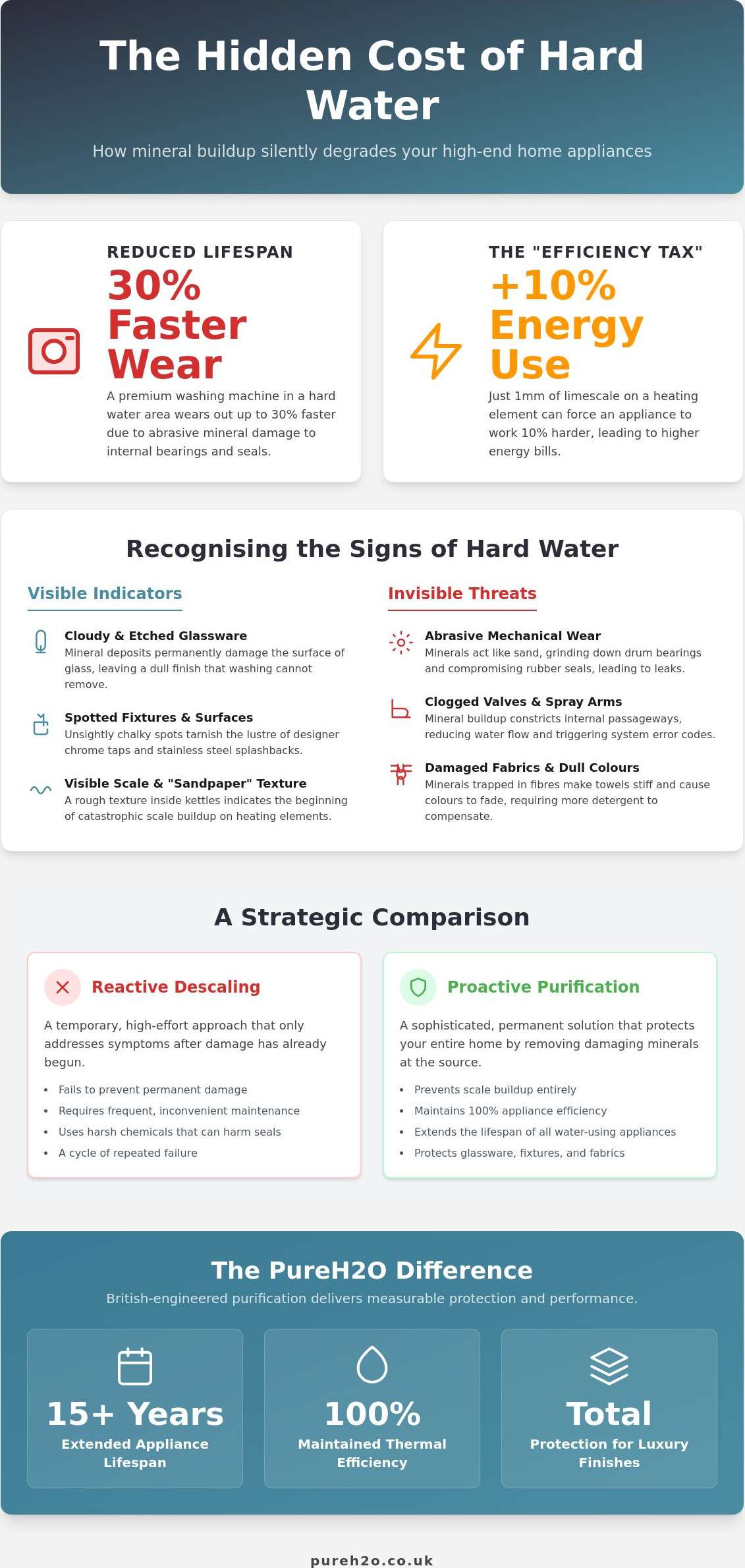
Did you know that hard water can cause a premium washing machine to wear out 30% faster than normal? For the homeowner who values precision and performance, the cost of ignoring water quality isn’t just a matter of unsightly marks; it’s a direct threat to the integrity of your bespoke kitchen investments. You’ve likely spent years curating a home that reflects your standards, so it’s disheartening to see designer fixtures dulled by limescale or to watch energy bills rise as heating elements lose their efficiency.
Recognising the subtle signs of hard water damage on appliances is the first step towards reclaiming the purity your home deserves. This guide will help you identify these mineral indicators before they lead to premature failure. You’ll learn how to protect your high-end appliances with British-engineered purification, ensuring they maintain 100% thermal efficiency whilst extending their lifespan to 15 years or more. We’ll explore the technical realities of mineral accumulation and how the PureH2O difference provides a sophisticated, permanent solution for the modern household.
Key Takeaways
- Learn to recognise the subtle indicators of mineral accumulation, from chalky deposits on heating elements to the loss of lustre on your favourite designer glassware.
- Understand how to identify the signs of hard water damage on appliances like washing machines and dishwashers before abrasive minerals compromise internal bearings and spray arms.
- Discover the hidden “efficiency tax” where even a single millimetre of scale can force your boiler to work 10% harder, leading to unnecessarily high energy bills.
- Evaluate why traditional descaling is a reactive failure and how proactive, British-engineered purification offers a permanent and sophisticated alternative.
- Explore how PurityPRO technology and reverse osmosis can extend the lifespan of your luxury appliances to 15 years or more whilst maintaining 100% thermal efficiency.
The Silent Destroyer: Identifying the Early Signs of Hard Water Damage
The internal mechanics of a high-end appliance are marvels of modern engineering, yet they remain vulnerable to a primitive threat. Hard water, characterised by high concentrations of dissolved minerals, acts as a silent destroyer within the home. Recognising the signs of hard water damage on appliances early is essential for any homeowner who wishes to preserve the longevity of their bespoke kitchen. One of the most obvious indicators is the “chalky” signature of calcium carbonate found on heating elements. This residue isn’t merely an aesthetic nuisance; it forms a thermal barrier that forces your appliance to consume more energy to achieve the same temperature.
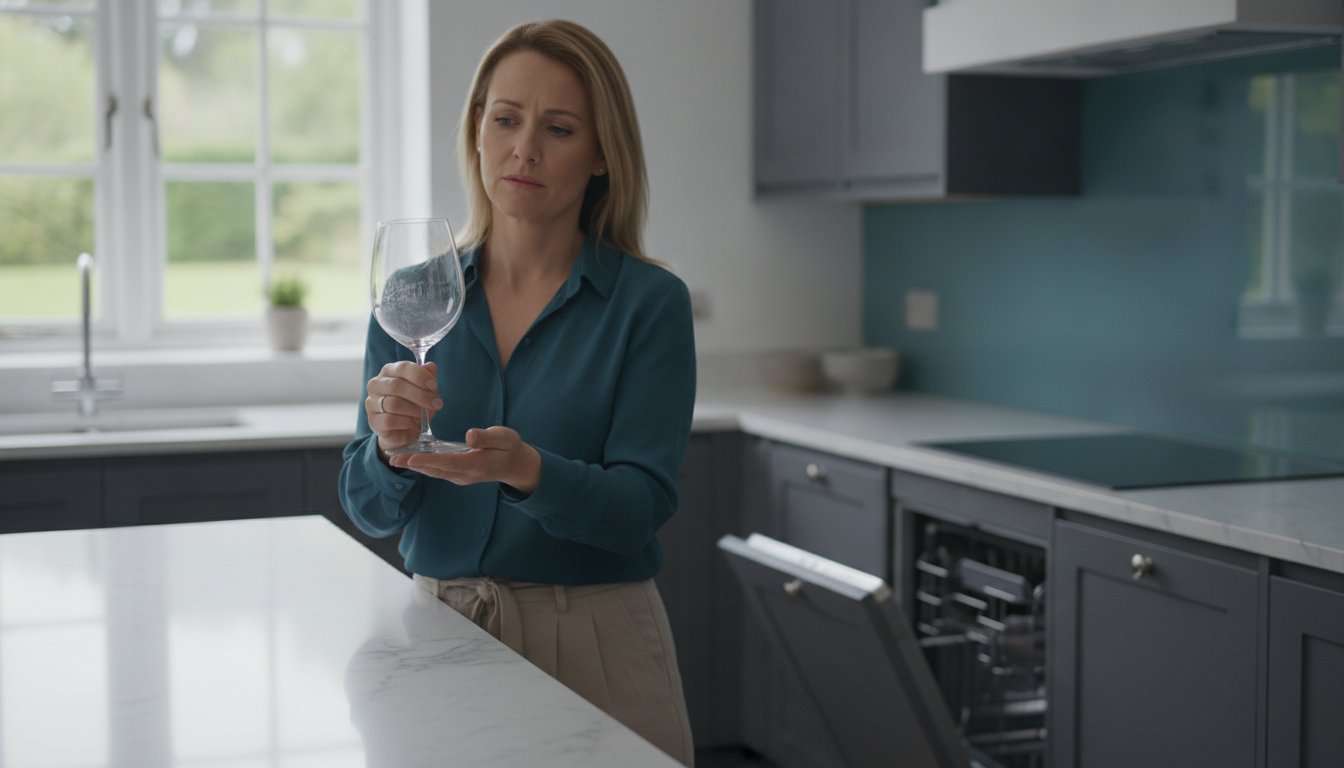
Beyond the hidden components, your designer glassware often provides the first visual warning. Whilst you might assume a cloudy finish is the result of a poor wash cycle, it’s actually the result of mineral deposits etching the surface of the glass. This loss of lustre is permanent once the etching occurs, making prevention through purification the only viable strategy. You may also notice a subtle but persistent reduction in water flow. Internal valves, designed for precision, become constricted by mineral buildup; this is a primary cause of the frustrating error codes that plague modern appliances.
Visible vs. Invisible Mineral Indicators
The indicators of hard water are often split between the obvious and the obscured. Surface spotting on stainless steel splashbacks or chrome taps is a common visible sign, but the true damage happens where you can’t see it. If you run your finger along the interior of a kettle or coffee machine and feel a “sandpaper” texture, you’re feeling the beginning of a catastrophic failure. This abrasive buildup eventually migrates to internal seals and valves, leading to leaks and mechanical seizures that often fall outside of standard manufacturer warranties.
The Science of Scaling in 2026
To understand the threat, one must understand what hard water is and how it behaves under heat. When water containing dissolved magnesium and calcium is heated, it undergoes thermal precipitation. Limescale is the solid byproduct of heated hard water. In 2026, modern high-efficiency appliances are more susceptible to this mineral damage than their predecessors. Because these units are engineered with tighter tolerances and smaller internal passageways to conserve water, even a minute amount of scaling can trigger a total system shutdown. Hard water also alters the chemical behaviour of soaps, requiring you to use significantly more detergent to achieve a standard lather, which adds to the internal residue left within your machines.
How Limescale Compromises Your Kitchen and Laundry Appliances
Whilst the previous section explored identification, we must now examine the mechanical consequences. Within a laundry environment, the signs of hard water damage on appliances often manifest as mechanical grinding sounds during a spin cycle. This occurs because minerals act as an abrasive agent, slowly wearing down drum bearings and compromising the integrity of rubber seals. Once these seals degrade, internal leaks become inevitable; often damaging sensitive electronic control boards before the user even notices a puddle. High-end machines like Miele or Gaggenau are engineered for precision, but they cannot withstand the constant friction of calcium deposits.
In the kitchen, the dishwasher bears the brunt of mineral precipitation. High-performance units rely on precise cleaning pressure, yet scale builds up within the narrow apertures of spray arms. This restriction reduces the force of the water, leaving you with residue on your plates and cutlery. For those with integrated coffee stations or steam ovens, the risk is even higher. These appliances utilise delicate internal boilers with minute passageways that fail at the first sign of scale. High-end culinary equipment is designed for precision, and using anything less than purified water is a recipe for a costly service call.
The Impact on Laundry and Textiles
Hard water doesn’t just damage the machine; it ruins the investment you’ve made in your wardrobe. Minerals become trapped amongst fabric fibres, making towels feel stiff and causing premature wear on delicate garments. You’ll notice a distinct dulling of colours whilst using standard wash cycles as the minerals prevent detergents from rinsing away properly. Scientific studies suggest that switching to a soft water environment allows for up to 50% less detergent usage, as the soaps are no longer fighting against calcium ions to create a lather.
Kitchen Performance and Aesthetics
The aesthetic toll of hard water is most visible on your table settings. Even with the finest rinse aids, streaky finishes on plates and glassware persist when minerals are present in the final rinse cycle. Over time, this same mineral accumulation causes the degradation of rubber gaskets in high-end dishwashing units, leading to a loss of suction and efficiency. To maintain the “as-new” performance of integrated smart taps and designer fixtures, a proactive approach to water quality is essential. Implementing a bespoke water softener or purification system ensures these high-performance components remain free from abrasive residues for their entire operational life.
The Efficiency Tax: Invisible Scaling and Rising Energy Costs
Whilst the mechanical failures discussed in previous sections are often loud and disruptive, the “Efficiency Tax” is a silent drain on your household finances. It’s one of the most pervasive signs of hard water damage on appliances, yet it remains largely invisible until the utility bills arrive. Limescale is, quite literally, a layer of rock that forms between your heating element and the water it’s meant to warm. Because minerals like calcium and magnesium are excellent thermal insulators, they resist heat transfer with remarkable efficiency, forcing your appliances to work harder than their designers ever intended.
For every millimetre of scale that accumulates on a heating element, your appliance must work approximately 10% harder to reach the same temperature. This isn’t just a theoretical loss; it’s a tangible increase in energy consumption that compounds every time you run a wash cycle or boil the kettle. Over a single year, this cumulative inefficiency can add significant sums to a household’s energy expenditure, effectively taxing you for the quality of your water. You’ll notice your appliances running for extended duty cycles, staying active for longer periods whilst producing less impressive results.
Quantifying the Energy Loss
The relationship between mineral thickness and heat transfer resistance is linear and unforgiving. Your boiler is the most vulnerable component in a hard water home, as it processes the highest volume of heated water. When scale coats the heat exchanger, the unit must run for longer to meet the thermostat’s demand. This leads to a variety of symptoms:
- Increased gas or electricity consumption for standard water heating
- Slow recovery times for hot water tanks and cylinders
- Audible “kettling” sounds as water becomes trapped behind scale layers and turns to steam
The Lifespan Deficit
There is a stark contrast between a home plagued by minerals and one protected by British-engineered purification. In hard water areas, premium appliances often face a 7-year failure rate, failing just as they should be entering their prime. By contrast, a home protected from the signs of hard water damage on appliances can expect a 15-year potential lifespan for the same equipment. This lifespan deficit feeds into a “disposable” appliance culture that is environmentally catastrophic. Choosing to eliminate abrasive mineral residues is more than a financial decision; it’s an act of environmental responsibility. PureH2O systems promote a sustainable, long-term home by reducing carbon footprints and preventing the premature disposal of complex machinery.
Reactive Maintenance vs. Proactive Protection: A Strategic Comparison
Many homeowners wait until they see the physical signs of hard water damage on appliances before taking action. This reactive approach is akin to treating a symptoms whilst ignoring the underlying cause. Descaling is a temporary fix; it’s a messy, recurring chore that only addresses surface deposits. True protection for a high-end home requires a fundamental shift from reactionary cleaning to scientific prevention. By the time you notice a chalky residue on your fixtures, the internal components of your appliances have likely already suffered significant mineral stress.
Choosing a proactive strategy means managing water quality at the point of entry. Automatic ion exchange remains the gold standard for whole-house protection, ensuring that every drop of water flowing through your pipes is stripped of its abrasive mineral content. For those who demand the ultimate in purity, managing Total Dissolved Solids (TDS) through reverse osmosis provides a level of protection that standard softeners simply cannot match. It’s the difference between merely managing a problem and eliminating it entirely.
The Flaws of Chemical Descaling
Chemical descalers often rely on harsh acids to dissolve stubborn calcium. Whilst these are effective at removing visible scale, they carry a hidden risk. These abrasive substances can be inadvertently corrosive to the delicate internal heating elements and sensors found in luxury coffee stations or steam ovens. Repeated exposure can lead to micro-pitting on stainless steel surfaces and the accelerated degradation of sensitive rubber gaskets. There’s also the persistent mental load of manual maintenance; descaling is an imperfect process that can never reach 100% of your home’s internal pipework.
The PureH2O Advantage
PureH2O provides a definitive answer through bespoke, industrial-grade engineering adapted for the discerning British home. We move beyond simple softening to achieve total water perfection. Our systems leverage advanced technology to ensure a 99.99% purity rate, a hallmark of our technical excellence that protects your investments from the first day of installation. Consider the Quatreau smart tap as a case study in scale-free innovation. It delivers boiling, chilled, and sparkling water with unrivalled precision, all whilst remaining entirely protected from the internal scaling that plagues inferior systems. To experience the pinnacle of water quality, explore our range of bespoke Water Softeners and purification solutions today.
Safeguarding Your Home with PureH2O’s Unrivalled Purification Technology
The PurityPRO Home Water Purifier represents the culmination of over 30 years of British engineering expertise. Whilst earlier sections detailed how to identify the signs of hard water damage on appliances, this technology ensures that such degradation becomes a concern of the past. Our systems are not merely filters; they are sophisticated water management solutions designed for the discerning homeowner who refuses to compromise on quality. By integrating our industrial-grade technology into a residential footprint, we provide a level of protection that standard consumer products cannot achieve.
At the heart of our most advanced systems lies Reverse Osmosis. This process is the scientific pinnacle of mineral and contaminant removal, capable of achieving a 99.99% purity rate. By forcing water through a semi-permeable membrane at high pressure, we remove the dissolved calcium and magnesium ions before they can ever precipitate into limescale. This isn’t just about softening; it’s about deionisation and total purity. Whether for a luxury residence, a commercial kitchen, or a high-tech industrial application, our bespoke solutions are engineered to meet the specific requirements of your infrastructure.
In professional settings where hygiene and presentation are paramount, it is often beneficial to visit That’s Cleaning to discover how their specialist commercial services can support your facility’s maintenance needs.
A Lifestyle of Purity and Performance
Choosing PureH2O is an investment in a lifestyle where health and infrastructure are protected simultaneously. The “PureH2O Difference” is evident in every drop, from the clarity of your ice to the sustained performance of your steam oven. This is sustainable luxury in its truest form. By eliminating the need for bottled water and preventing the premature failure of appliances, you significantly reduce both plastic waste and energy consumption. It’s a commitment to a plastic-free future that doesn’t sacrifice the high-performance standards you expect from your home’s mechanical systems.
Next Steps for Your Home
Protecting your bespoke interior requires a precise understanding of your local water chemistry. Every installation begins with a comprehensive on-site water analysis to determine the exact mineral profile of your supply. Our expert British engineers then design and install a system tailored to your home’s specific flow rates and appliance requirements. This methodical approach ensures that your purification technology performs with unrivalled reliability for decades to come. To begin the journey towards total water perfection, organise your bespoke water analysis with PureH2O today and secure the future of your home’s most valued investments.
Securing the Future of Your Bespoke Home
Preserving the integrity of your luxury investments requires more than just regular maintenance; it demands a fundamental shift in how you manage your home’s water quality. We’ve explored how mineral accumulation acts as a silent destroyer, from the hidden efficiency tax on your energy bills to the abrasive wear on delicate mechanical bearings. By identifying the early signs of hard water damage on appliances, you’ve taken the first step toward reclaiming your home’s performance and aesthetic lustre.
PureH2O has led the way in British-made engineering since 1991, adapting bespoke industrial-grade solutions for the discerning residential market. Our commitment to an unrivalled 99.99% purity metric ensures that your high-end appliances remain free from the threat of limescale for their entire operational life. It’s time to move beyond reactive descaling and embrace a lifestyle of sustainable purity. Discover the PurityPRO: The ultimate protection for your home and experience the peace of mind that comes with scientific excellence. Your home deserves nothing less than the absolute pinnacle of water purification technology.
Frequently Asked Questions
Is hard water actually damaging my washing machine?
Yes, hard water is a primary cause of mechanical failure in modern laundry equipment. Whilst older machines had simpler components, today’s high-efficiency units use less water, which concentrates the abrasive effect of minerals on drum bearings and solenoid valves. These signs of hard water damage on appliances often begin with minor leaks or increased vibration during spin cycles, eventually leading to a total seizure of the internal mechanics that standard descaling cannot reverse.
Can I remove existing limescale damage from my appliances?
You can remove surface-level calcium deposits using chemical agents, but the internal mechanical wear caused by minerals is permanent. Once magnesium and calcium have caused micro-pitting on a heating element or abraded a rubber seal, the structural integrity of that component is compromised. Whilst cleaning might restore some visual lustre to your fixtures, it cannot repair the internal friction damage that has already occurred within the machine’s bespoke engine.
How much does hard water increase my monthly energy bills?
Hard water typically increases the energy required for water heating by approximately 10% for every millimetre of scale buildup. This “Efficiency Tax” occurs because the mineral layer acts as a thermal insulator, forcing your boiler or immersion heater to run for longer to achieve the desired temperature. In a high-performance home, this cumulative inefficiency can add significant costs to your annual utility expenditure whilst rendering “eco” modes largely ineffective.
Do water softeners really extend the life of a boiler?
Professional water softeners can effectively double the operational lifespan of a domestic boiler. By removing the minerals before they reach the heat exchanger, you prevent the “kettling” and overheating that lead to premature component failure. A boiler protected from mineral precipitation maintains its factory-standard thermal efficiency, ensuring it reaches its 15-year potential rather than failing at the common 7-year mark seen in hard water areas.
What is the difference between a water softener and a PureH2O purifier?
A standard water softener primarily exchanges calcium and magnesium ions for sodium to prevent scale. In contrast, a PureH2O purifier, such as the PurityPRO, utilises advanced reverse osmosis technology to achieve a 99.99% purity rate. This process removes not just minerals, but also microplastics, heavy metals, and chlorine. Whilst a softener protects your plumbing, a PureH2O system provides the scientific pinnacle of water quality for both your home’s health and its infrastructure.
Will a whole-house system affect my water pressure?
A professionally engineered PureH2O system is bespoke-designed to maintain your home’s existing flow rates and pressure requirements. Our British engineers ensure that the internal diameters of our purification units match your specific plumbing infrastructure. This meticulous attention to detail prevents the pressure drops often associated with inferior, off-the-shelf filtration units, allowing you to enjoy purified water without compromising the performance of your luxury rain showers or smart taps.
How often do PureH2O systems require maintenance or filter changes?
To maintain our hallmark 99.99% purity metric, we recommend an annual service by one of our expert engineers. During this visit, we replace filter cartridges and conduct a thorough system health check to ensure your technology continues to perform at its peak. This proactive maintenance schedule is designed to be unobtrusive, providing you with the confidence that your home’s water quality remains unrivalled without requiring any daily intervention on your part.
Is it better to descale appliances or prevent scale entirely?
Prevention is the only logical strategy for a discerning homeowner. Descaling is a reactive process that involves introducing harsh acids into your appliances, which can corrode delicate sensors and seals over time. By preventing the signs of hard water damage on appliances through point-of-entry purification, you eliminate the need for abrasive chemicals. This proactive approach preserves the “as-new” performance of your culinary equipment and ensures a more sustainable, maintenance-free lifestyle.
Disclaimer
The content of this article represents the views of the author and 36years practical experience.