

Tap Water Bacteria in the UK: A Scientific Guide to Biological Purity
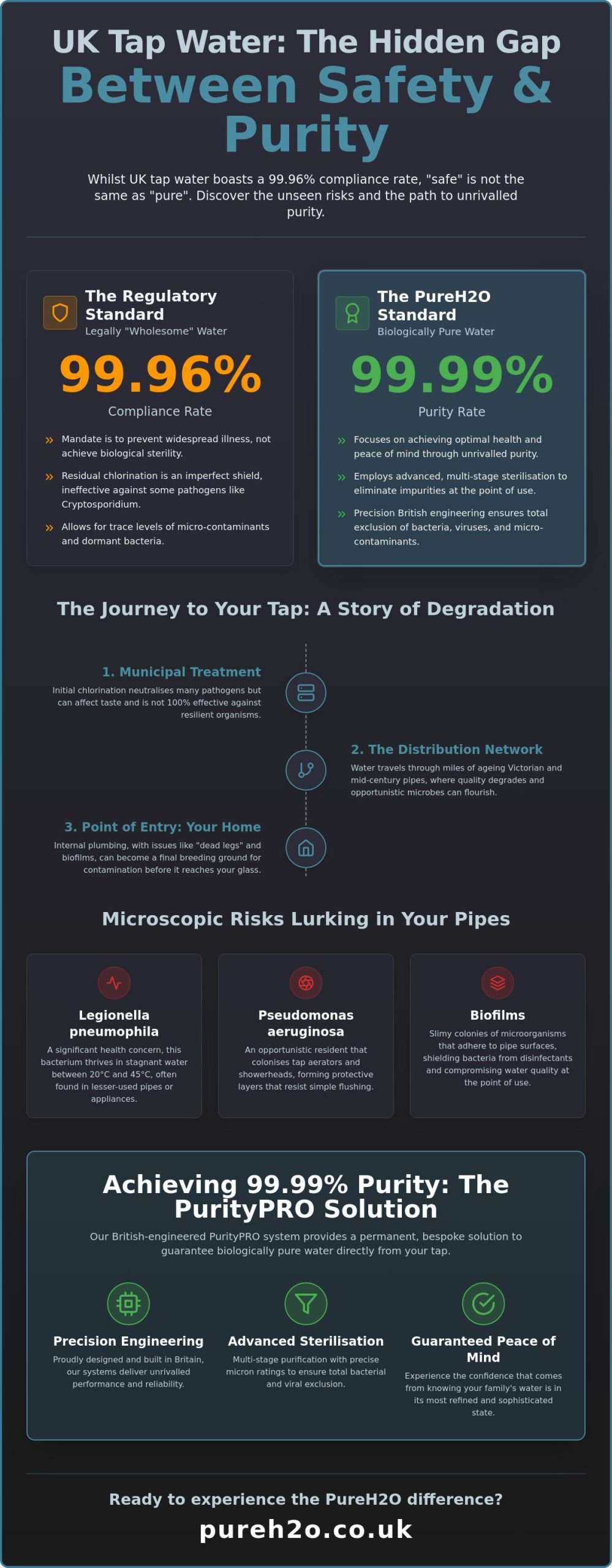
Does a 99.96% compliance rate truly guarantee the biological purity your family deserves? Whilst UK regulations are amongst the strictest in the world, the presence of resilient tap water bacteria and the gradual degradation of ageing municipal infrastructure mean that "safe" water is not always synonymous with "pure" water. You likely feel a growing sense of unease regarding the long-term health impacts of micro-contaminants that survive standard chlorination. It’s a valid concern, especially when conflicting information makes it difficult to discern between meeting a minimum legal standard and achieving genuine excellence in hydration.
This guide clarifies the hidden reality of microbial life in British pipes and explains how to bridge the gap between regulatory safety and unrivalled purity. You’ll discover the science behind the PureH2O Difference, including our British-engineered PurityPRO system, which provides a permanent, bespoke solution for the home. We will explore the technical precision required to eliminate 99.99% of impurities, ensuring you can finally experience the peace of mind that comes with water in its most refined and sophisticated state.
Key Takeaways
- Distinguish between “wholesome” water as defined by the DWI and the unrivalled biological purity required for a truly refined lifestyle.
- Identify the specific tap water bacteria that persist within ageing municipal infrastructure and the difference between indicator organisms and true pathogens.
- Uncover the science of biofilms and how common plumbing issues, such as “dead legs,” can compromise your water quality at the point of use.
- Evaluate the efficacy of advanced sterilisation methods and understand why precise micron ratings are critical for total bacterial exclusion.
- Discover the PureH2O Difference and how our PurityPRO technology achieves a 99.99% purity rate through precision British engineering.
Understanding Tap Water Bacteria in the UK: Safety vs. Purity
The UK’s water supply is frequently cited as being amongst the safest in the world, boasting a 2023 compliance rate of 99.96% against regulatory standards. However, for the discerning homeowner, the distinction between "safe" and "pure" is profound. Whilst the Drinking Water Inspectorate (DWI) ensures that tap water pollution, both ionic and bacteriological, is managed to prevent widespread illness, their mandate is to provide "safe" water rather than pure water. This legal standard allows for legally permitted levels of foreign substances and micro-organisms that, whilst not thought to cause immediate health concerns, fall far short of the unrivalled purity achieved through bespoke British-made purifiers such as PurityPRO and RODI+ systems from PureH2O ltd.
The Role of the Drinking Water Inspectorate (DWI)
The DWI acts as the independent regulator for water quality in England and Wales, monitoring companies against the Water Supply (Water Quality) Regulations 2016. They focus on Schedule 1 and Schedule 2 parameters, mandating zero detections of E. coli in 100ml samples. However, a "zero detection" in a periodic sample doesn’t mean the entire network is sterile. Tap water bacteria can persist in dormant states within the vast, complex distribution system, surviving in dead legs that sampling might miss.
Chlorination: A Necessary but Imperfect Shield
Municipal providers rely on residual chlorination to neutralise pathogenic micro-organisms during transit. Whilst effective against many bacteria, chlorine is an imperfect shield. Pathogens like Cryptosporidium are famously chlorine-resistant and can bypass standard treatment. This chemical process also compromises the water’s taste and odour, forcing a compromise between basic safety and the refined quality that PureH2O clients expect from their home supply.
The journey from the treatment plant to your kitchen tap is often several miles long. During this transit, water quality inevitably degrades. Infrastructure age, temperature fluctuations, and pressure changes all encourage the growth of opportunistic microbes. By the time the water reaches your glass, it has been exposed to miles of ageing Victorian and mid-century pipes. This degradation makes a final, point-of-use purification system the only way to guarantee a 99.99% purity rate. Relying solely on municipal treatment means accepting the limitations of a system designed for the masses rather than the precision required for optimal health.
While focusing on the quality of water entering the home, it is equally important to manage the wastewater system; for those with private drainage, you can read more about Lil’ Stinky Septic Service to ensure that regular septic maintenance prevents any risk of groundwater contamination.
Common Pathogens: Identifying the Microscopic Risks in Your Pipes
Whilst the water entering your property usually meets the baseline UK drinking water safety standards, the internal plumbing of a modern home can inadvertently foster a variety of tap water bacteria. These microorganisms are not merely a theoretical concern; they are biological realities that thrive in specific domestic conditions. Environmental factors, particularly temperature and stagnation, dictate which species will colonise your pipes. For example, cold water pipes running parallel to uninsulated hot water lines can reach the ambient temperatures required for rapid microbial proliferation.
Modern luxury appliances often introduce hidden vulnerabilities. Integrated coffee stations, ice makers, and smart refrigerators contain intricate internal tubing where water remains stationary at room temperature for extended periods. These components are notoriously difficult to sanitise, providing a perfect incubator for microscopic life that standard municipal treatment cannot address at the point of use.
Legionella and Pseudomonas: The Opportunistic Residents
Coliforms and E. coli: Indicators of System Failure
Coliforms are generally classified as "indicator" bacteria. Whilst many strains are not inherently pathogenic, their detection suggests a breach in the supply chain’s integrity or a failure in the disinfection process. E. coli is a more serious matter. Strains like E. coli O157 can enter the domestic supply through catastrophic pipe bursts or sewage ingress during extreme weather events. When these failures occur, water authorities issue "Boil Water Notices." These measures are inherently reactive; by the time the alert reaches your smartphone, the contaminated water may have already been consumed. To ensure your home’s ecosystem remains truly sterile, you might consider an on-site water analysis to identify specific local risks.
Achieving a lifestyle of true health-consciousness requires moving beyond reactive safety. It demands a proactive approach to tap water bacteria, ensuring that every drop consumed is as pure as the day it was engineered. By understanding these microscopic risks, you can take the necessary steps to implement a permanent, bespoke solution that guarantees 99.99% purity regardless of external municipal failures.
The Biofilm Problem: Why Contamination Often Starts at Home
Even the most sophisticated kitchen can harbour these risks. Tap aerators, flexible hoses on pull-out sprays, and even the internal seals of luxury appliances provide ideal surfaces for attachment. Once established, these biofilms act as a persistent source of contamination that operates independently of the water company’s efforts.
How Biofilms Protect Bacteria from Chlorine
The resilience of these colonies lies in their extracellular matrix, a protective shield that bacteria secrete to anchor themselves. This biofilm is incredibly effective at protecting microbes from chemical disinfectants like chlorine preventing it from reaching the microbes beneath. Research into the microbial ecology of water distribution systems shows that these environments are dynamic. Periodically, the biofilm reaches a critical mass and sheds "slugs" of bacteria into the flow of water. This means your drinking glass could receive a concentrated dose of microorganisms even if the incoming supply is technically compliant. Removing an established biofilm from a home’s internal pipework is notoriously difficult and often requires aggressive intervention that can damage delicate fixtures.
The Danger of Inadequate Filtration
Many homeowners attempt to solve this with standard jug filters or basic under-sink carbon units. However, without the PureH2O Difference, these systems can actually worsen the problem. Standard carbon filters are designed to adsorb chlorine and organic chemicals. Once the chlorine is removed, the filter media becomes an ideal, nutrient-rich environment for tap water bacteria to thrive.
Over time, bacteria can "grow through" the filter media, a process known as breakthrough. This results in the filtered water having a higher bacterial count than the water entering the system. To achieve unrivalled purity, a multi-stage approach is essential. This includes high-performance reverse osmosis to remove the nutrients bacteria need, followed by ultraviolet water sterilisation. This UV stage acts as the definitive final barrier, ensuring that any stray microorganisms are neutralised before they reach your glass. It’s the only way to transform your home’s water from merely "filtered" to scientifically pure.
Evaluating Solutions: From Standard Filters to Advanced Sterilisation
Relying on the occasional boil-water notice or a rudimentary filter jug is an insufficient strategy for those who demand absolute biological safety from tap water bacteria. Whilst boiling water for one minute is effective at killing most pathogens, it’s a reactive and impractical solution for a modern, high-performance household. It doesn’t remove physical debris, heavy metals, or the chemical by-products of disinfection. To achieve a truly refined quality of life, your water strategy must move from temporary measures to a sophisticated, engineered exclusion process.
The efficacy of any system is fundamentally dictated by its micron rating. Most tap water bacteria range from 0.2 to 2 microns in size. If a filter’s pore size is 1 micron or larger, it acts as a sieve with holes too wide to catch the most resilient microorganisms. Reverse Osmosis (RO) represents the pinnacle of physical purification. By forcing water through a semi-permeable membrane at high pressure, it excludes contaminants at a molecular level. This process doesn’t just reduce bacteria; it removes the nitrates and organic matter they require to thrive, effectively starving any potential colonies. Such precise mineral and microbial management is equally critical in specialised domestic applications such as fishkeeping, where enthusiasts sourcing delicate species from CU Aquatics rely on pure RO water to maintain optimal aquatic ecosystems.
Why Filter Jugs and Basic Carbon Filters Fail
Standard consumer-grade filters often provide a false sense of security. These units typically lack a definitive "kill stage," meaning they only trap a portion of the tap water bacteria. Without an active antimicrobial mechanism, the filter housing itself can become a reservoir for re-contamination. This is especially true for filter jugs, where the water sits at room temperature after the chlorine has been removed. Bacteria can proliferate within the filter media itself, eventually leading to "breakthrough" where the output water is less pure than the input.
The Power of Ultraviolet (UV) Water Sterilisation
To achieve the 99.99% purity hallmark of the PureH2O Difference, physical filtration must be paired with ultraviolet water sterilisation. UV-C light at a specific wavelength of 254nm penetrates the cell walls of microorganisms and permanently disrupts their DNA. This ensures that even the most microscopic pathogens are rendered biologically inert and unable to reproduce. Within our PurityPRO Home Water Purifier, this technology is seamlessly integrated as a final, fail-safe barrier. It provides the peace of mind that comes with knowing your water is biologically sterile at the exact moment it leaves the tap.
Discover how the PurityPRO Home Water Purifier delivers the absolute pinnacle of water safety for your household.
Achieving 99.99% Purity: The PureH2O Scientific Approach
Every installation we perform is bespoke. We recognise that the water profile in a Chelsea townhouse differs from that of a rural estate in the Cotswolds. Our engineers conduct a thorough assessment to ensure the solution is perfectly calibrated to your home’s specific plumbing architecture. This meticulous attention to detail is a hallmark of our British engineering heritage, ensuring that the technology performs flawlessly for decades rather than years.
The PurityPRO Difference: Multi-Stage Excellence
The PurityPRO Home Water Purifier represents the absolute pinnacle of domestic water treatment. It utilises a sophisticated multi-stage process where high-performance reverse osmosis works in perfect synergy with ultraviolet water sterilisation. This combination does more than just neutralise tap water bacteria. It effectively excludes microplastics, nitrates, fluoride, and heavy metals that standard filters leave behind. The result is water that is chemically and biologically unrivalled, providing a foundation for a plastic-free, sustainable future without sacrificing the luxury of performance.
Smart Taps and Seamless Integration
The delivery of such pure water requires a system that matches the sophistication of the purification process itself. The Quatreau Smart Tap range is the ultimate interface for the modern kitchen. With intuitive touch-control technology, it provides instant access to boiling, chilled, and sparkling water, all purified to our exacting 99.99% standard. This isn’t just about convenience; it’s about enhancing the sensory experience of your home. Pure water elevates the flavour of organic produce, unlocks the true profile of artisanal coffee, and provides the ultimate peace of mind for your family’s health.
To begin your journey towards total biological purity, we invite you to book a bespoke on-site water analysis. Our experts will provide a detailed breakdown of your current water quality and design a tailored solution that brings the PureH2O Difference into your home.
Elevating Your Home to the Pinnacle of Biological Purity
Whilst regulatory bodies maintain a baseline of safety, the persistent nature of tap water bacteria within domestic plumbing requires a more sophisticated response. You’ve seen how biofilms and ageing infrastructure can compromise even the most wholesome supply; you’ve also discovered why standard filtration often falls short of the mark. True biological purity is achieved only through a meticulous, multi-stage approach that combines molecular-level exclusion with advanced ultraviolet sterilisation.
With over 30 years of expertise, PureH2O remains at the forefront of high-end water purification. Our British-engineered systems are designed to achieve a definitive 99.99% purity rate, a standard of excellence trusted by discerning luxury homeowners and industrial semiconductor manufacturers alike. In such high-tech environments, businesses often partner with The CFS Group for tailored facilities management solutions that ensure their operations run seamlessly. This isn’t merely a household upgrade; it’s a permanent investment in your family’s health and a commitment to a refined, sustainable lifestyle. It’s time to move beyond the limitations of municipal water and experience the unrivalled clarity that only bespoke engineering can provide.
Experience the PureH2O Difference: Explore the PurityPRO Home Purifier
Frequently Asked Questions
Is it safe to drink tap water in the UK in 2026?
Yes, UK tap water remains amongst the safest globally, with a 2023 compliance rate of 99.96% against Drinking Water Inspectorate standards. However, whilst it meets the legal definition of "wholesome," it’s not synonymous with "pure." Even compliant water can contain trace micro-contaminants or resilient tap water bacteria that survive municipal treatment or enter the supply through ageing domestic plumbing and biofilms.
Does boiling tap water remove all types of bacteria?
Boiling water at a rolling boil for at least one minute will neutralise most pathogenic bacteria, viruses, and cysts. It serves as an effective emergency measure but fails to remove bacterial toxins, heavy metals, or chemical residues like chlorine. It’s also an impractical daily solution for a modern household and doesn’t address the physical presence of dead microbial matter that advanced purification removes entirely.
Can bacteria grow inside my home water filter system?
Bacteria can indeed proliferate within standard home filters, especially those using carbon media without a secondary sterilisation stage. Once chlorine is removed, the filter housing becomes a nutrient-rich environment where tap water bacteria can colonise and thrive. Over time, this can lead to "breakthrough," where the bacterial count in the filtered water actually exceeds that of the incoming supply, necessitating a more sophisticated multi-stage approach.
What are the symptoms of bacteria in tap water?
Acute symptoms of bacterial contamination typically manifest as gastrointestinal distress, such as nausea, stomach cramps, and diarrhoea. However, the long-term health impacts of consuming trace levels of micro-contaminants are often more subtle and asymptomatic. Discerning homeowners frequently identify issues through a "chlorine" taste or metallic odour, which suggest the water’s biological profile is less than optimal for refined health.
How does ultraviolet (UV) sterilisation differ from standard filtration?
Standard filtration is a physical process that sieves out particles based on size, whilst ultraviolet (UV) sterilisation is a biological process that neutralises microorganisms at a molecular level. UV-C light penetrates the cell walls of bacteria and disrupts their DNA, rendering them unable to reproduce. Whilst high-performance filters provide the necessary physical barrier, UV sterilisation acts as the essential final fail-safe to ensure 99.99% biological purity.
What is the best water purifier for removing 99.99% of bacteria?
The PurityPRO Home Water Purifier is the definitive solution for achieving a 99.99% purity rate. It utilises a bespoke combination of high-precision reverse osmosis and integrated ultraviolet water sterilisation to exclude even the most resilient pathogens. Engineered in Britain to meet the exacting standards of luxury homeowners and high-tech industries, it provides a level of biological and chemical purity that standard consumer-grade filters simply cannot match.
Does reverse osmosis remove Legionella and E. coli?
Reverse osmosis is exceptionally effective at removing both Legionella and E. coli because the pore size of the semi-permeable membrane is significantly smaller than these bacteria. The membrane acts as a physical barrier that only allows water molecules to pass through, excluding microorganisms and other contaminants. When this process is paired with UV sterilisation, it creates a comprehensive, multi-stage barrier that ensures your drinking water remains biologically sterile.
How often should I change my filter cartridges to prevent bacterial growth?
Replacement filter cartridges should typically be changed every six to twelve months, depending on your local water quality and usage volume. Adhering to a strict maintenance schedule is vital to prevent the accumulation of organic matter that can foster bacterial growth within the system. High-performance systems like the PurityPRO ensure the integrity of your home’s water purity by providing clear indicators of when a professional service is required.
Disclaimer
The content of this article represents the views of the author and 36years practical experience.