
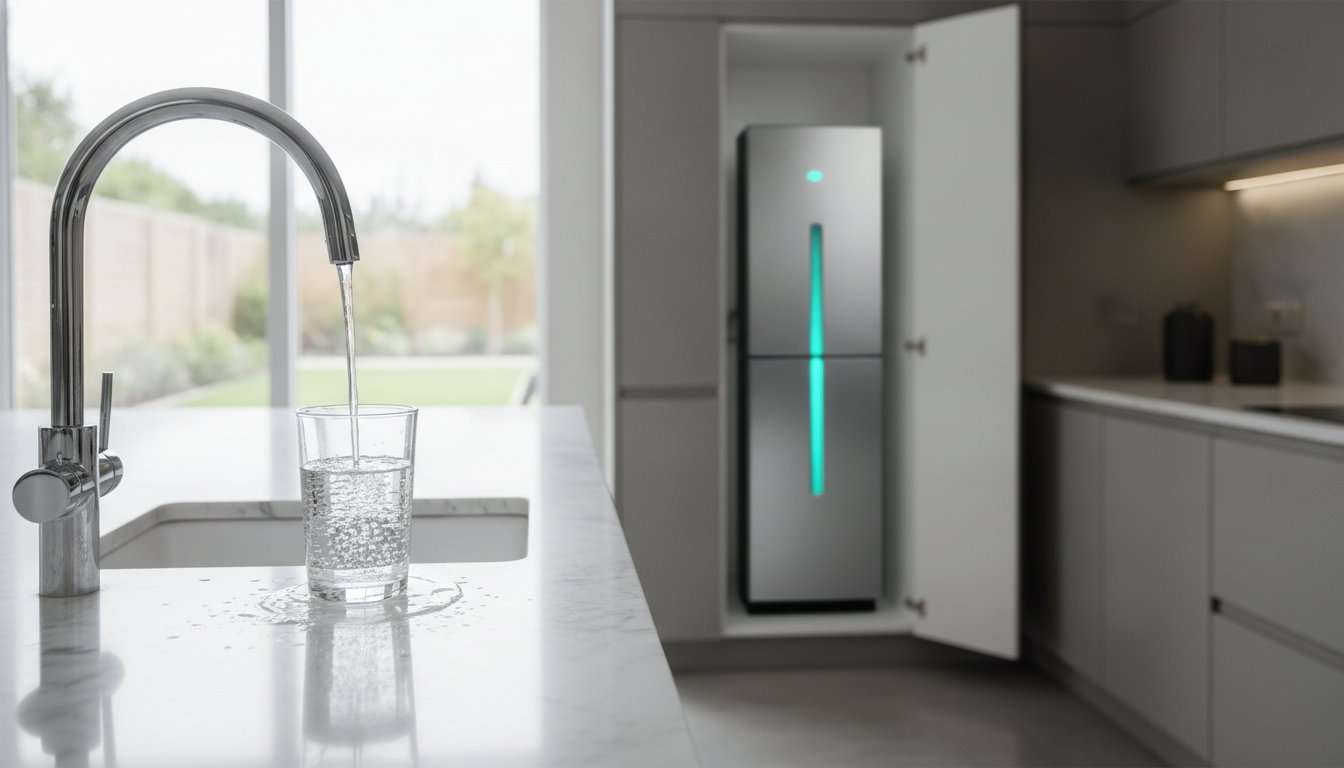
The Ultimate Guide to Water Softeners: Protecting Your Home with British Engineering
Could the water flowing through your bespoke kitchen be the single greatest threat to your investment? For those living in hard water areas like London or the South East, the reality of limescale is more than a cosmetic nuisance. It is a silent predator that degrades expensive steam ovens, dulls designer fixtures, and forces boilers to work harder, which inevitably inflates your energy bills. Whilst many view a water softener as a mere utility, it is actually the first line of defence in a sophisticated, high-performance home ecosystem.
We understand that you expect more from your home than just basic functionality; you deserve a solution that pairs British engineering with unrivalled precision. This guide reveals how bespoke softening technology preserves your property, restores the natural vitality of your skin and hair, and serves as the essential foundation for achieving 99.99% purity. We will examine the transition from abrasive mains water to a refined system that integrates perfectly with your luxury kitchen technology, ensuring your home remains a sanctuary of health and efficiency.
Key Takeaways
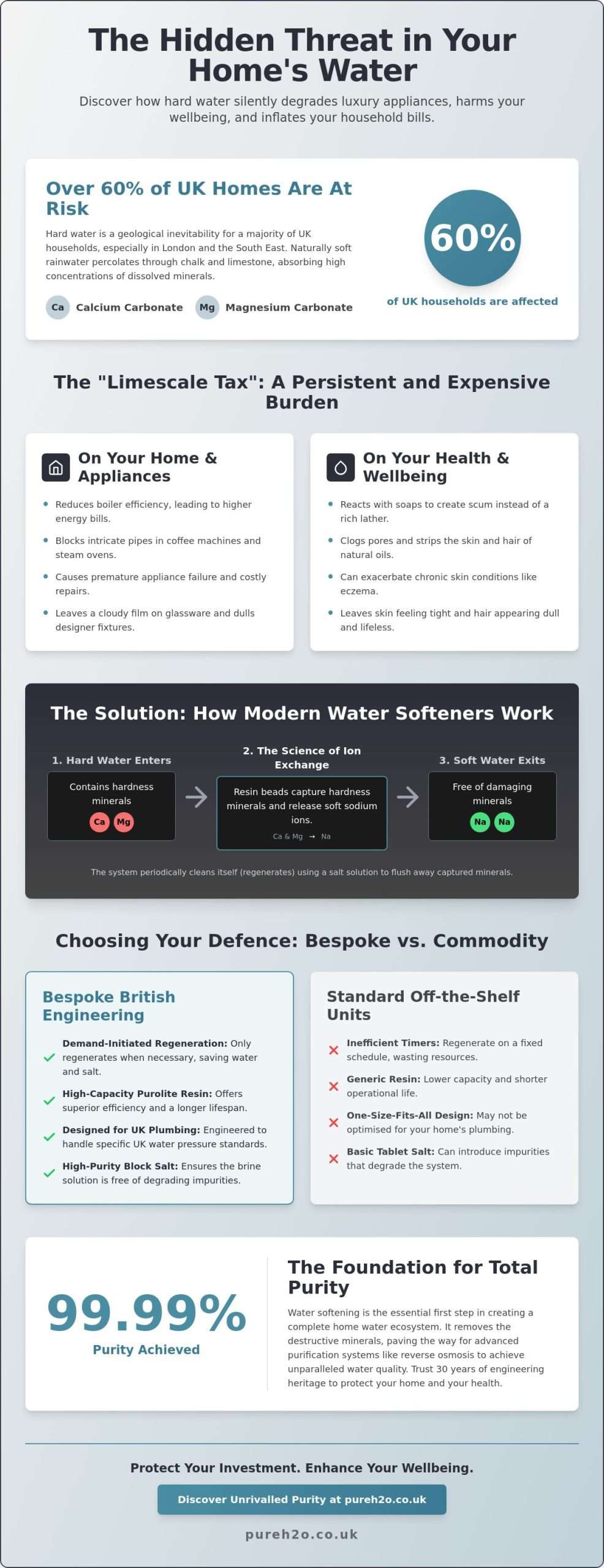
- Understand why over 60% of UK homes are affected by hard water and the specific risks this poses to high-end appliances and energy efficiency.
- Learn how the ion exchange process in a bespoke water softener preserves your home by effectively removing damaging mineral deposits.
- Compare the long-term value of British-engineered systems against commodity units to ensure your investment is protected for years to come.
- Discover the essential role of water softening as the foundation for a total purity ecosystem that includes advanced reverse osmosis.
- Explore how the PureH2O Difference combines 30 years of engineering heritage with a commitment to achieving 99.99% pure water.
Understanding the Hard Water Crisis in British Homes
Hard water is defined by its high concentration of dissolved calcium and magnesium carbonates. In the UK, this is a geological inevitability for approximately 60% of households. Rainwater is naturally soft, but as it percolates through the chalk and limestone prevalent in regions like London, Kent, and the Home Counties, it absorbs minerals that eventually manifest as destructive limescale. Whilst these minerals aren’t hazardous to health, they are catastrophic for the infrastructure of a modern home. Understanding the science of water softening is essential for anyone looking to mitigate this invisible threat.
The Impact on Your Luxury Appliances
High-end boilers are designed for peak performance, yet even a thin layer of scale can reduce thermal efficiency by a significant margin. This forces the system to consume more energy to achieve the same temperature, directly inflating your monthly bills. Whilst heating and boiler specialists such as gas2heat.com can provide routine servicing to keep central heating systems running efficiently, preventing mineral build-up at the source remains essential. For those with bespoke coffee stations or integrated steam ovens, the risk is even more acute. These precision instruments rely on intricate internal capillaries that are easily blocked by mineral deposits. The “Limescale Tax” is the unavoidable financial burden of premature appliance failure and inflated energy costs faced by every unequipped household in a hard water area.
Proper appliance care goes beyond water treatment; for instance, maintaining filters and sourcing quality replacement components through specialists like Hvidevaredele.dk is a vital part of ensuring your home technology lasts for its intended lifespan.
Health and Wellbeing: Beyond the Pipes
How Modern Water Softeners Work: The Science of Ion Exchange
The core of every high-performance water softener is a process known as ion exchange. It’s a sophisticated chemical swap where the calcium and magnesium ions responsible for limescale are captured and replaced with sodium ions. This happens within a vessel filled with millions of microscopic resin beads. These beads act like a magnet, pulling the hardness minerals out of the water as it flows through the system. For a home to maintain its pristine condition, this process must be both continuous and efficient.
The longevity of this system depends heavily on the quality of the resin and the intelligence of the control valve. Modern, demand-initiated systems monitor your actual water usage rather than relying on a simple timer. This ensures the system only regenerates when necessary, significantly reducing water and salt consumption. High-performance engineering is vital here; according to the EPA on water softener efficiency, these sensor-based systems are far more resource-efficient than their basic counterparts. These systems are specifically designed with British-made components to handle the unique water pressure standards found in UK plumbing, which often differ significantly from continental systems.
The Role of Resin and Salt in Softening
The resin bed is the engine of the system. High-capacity resins, such as the premium Purolite used in bespoke British systems, offer a greater surface area for ion exchange. This means the system can soften more water before needing to clean itself, which extends the lifespan of the media. When the resin is saturated, the system enters a regeneration cycle, flushing the captured minerals away using a brine solution. Whilst budget units might use generic tablet salt, precision-engineered systems are often designed for high-purity block salt, ensuring the brine remains free of impurities that could degrade the resin over time.
Bespoke vs. Off-the-Shelf Engineering
A common mistake is assuming any water softener will suffice for a luxury home. Off-the-shelf units from DIY retailers are often undersized, struggling to maintain soft water during periods of high demand, such as when multiple rain-showers are running simultaneously. A bespoke approach begins with a professional on-site water analysis. This allows engineers to calibrate the system to your specific mineral levels and plumbing requirements, ensuring consistent flow rates and longevity. Ensuring your system is calibrated for high-flow luxury fixtures prevents the drop in pressure often associated with inferior units. If you are seeking a system tailored to your home’s unique requirements, exploring bespoke water softeners is the definitive next step to protect your investment.
Comparing Water Softening Solutions: Bespoke vs. Commodity
When selecting a water softener, the temptation to opt for an entry-level DIY unit can be significant. However, these commodity products are often built to a price point rather than a performance standard. A bespoke system is an investment in your home’s infrastructure, designed to withstand the rigours of British water chemistry for decades. Whilst a budget unit might appear cost-effective initially, the total cost of ownership over ten years frequently tells a different story. High maintenance requirements, inefficient salt consumption, and the inevitable need for replacement often make “cheap” units the most expensive choice in the long run.
Choosing a professionally engineered system ensures that every component is matched to your specific household needs. This includes an analysis of your peak flow requirements and local mineral concentrations. A commodity unit from a high-street retailer simply cannot offer this level of precision. By investing in superior British engineering, you’re not just buying a product; you’re securing a long-term solution that integrates seamlessly with your luxury appliances and provides consistent, unrivalled performance.
The Myth of the Salt-Free Softener
It’s vital to distinguish between water “conditioning” and true water softening. Many products marketed as salt-free or electronic descalers don’t actually remove the minerals from your water. Instead, they attempt to alter the crystalline structure of calcium to prevent it from sticking to surfaces. Whilst this might offer some protection for pipes, it fails to provide the luxurious “slippery” feel of soft water or the health benefits for skin and hair discussed previously. Scientific evidence confirms that ion exchange is the only domestic technology capable of physically removing calcium and magnesium ions from the water supply to achieve a hardness level of near zero.
Installation and Commissioning Standards
The performance of even the finest water softener can be compromised by poor installation. Common issues with DIY or amateur setups include significant pressure drops that ruin the experience of a luxury rain-shower and the formation of “salt bridges” in the brine tank. Professional commissioning ensures the system is perfectly calibrated to your local water hardness and household demand. A comprehensive Platinum Service Contract should provide more than just a yearly check-up; it should offer proactive monitoring, resin bed sanitisation, and a guarantee of continued performance. By prioritising British craftsmanship and precision engineering, PureH2O ensures that your system remains a dependable pillar of your home’s water ecosystem.
Designing Your Home Water Ecosystem
Whilst a water softener is indispensable for protecting your home’s infrastructure, it represents only the first stage of a truly refined water strategy. We advocate for a concept of “Total Purity,” where softening technology works in tandem with advanced purification to address every aspect of water quality. By removing calcium and magnesium at the point of entry, the softener serves as a protective shield for more delicate systems. This ensures that your home’s water ecosystem operates with unrivalled efficiency and longevity.
The PurityPRO Home Water Purifier represents the apex of this synergetic approach. This system relies on sophisticated membranes to achieve 99.99% purity, but these components are sensitive to mineral scaling. Integrating a softener ensures these membranes remain pristine, extending the service life of your purification technology whilst maintaining peak performance. This integrated design philosophy moves beyond simple plumbing to create a high-performance environment for your family.
Why You Should Not Drink Softened Water
The ion exchange process inherently increases the sodium content of your water. Whilst this is perfectly suited for bathing or laundry, it can exceed the recommended 200 mg/l limit for drinking water in exceptionally hard areas. This sodium can alter the delicate flavour profile of premium teas and coffees. It also presents a consideration for those monitoring their salt intake for health reasons. A truly sophisticated home requires a secondary stage of treatment. Reverse Osmosis is the definitive solution here, as it effectively removes the sodium added by the softening process. By installing a dedicated purification tap, you ensure that the water you consume is not just soft, but fundamentally pure.
The Synergetic Kitchen: Softeners and Smart Taps
The kitchen is the heart of the modern home, and its technology deserves the highest level of protection. Softened water is essential for the longevity of the Quatreau Smart Tap range, particularly for those models providing instant boiling water. Limescale is the primary cause of failure in boiling water tanks, but a bespoke softener eliminates this risk entirely. For the ultimate in safety and sustainability, we recommend integrating Ultraviolet water sterilisation and a PureH2O Bottling Station. This allows you to enjoy chilled, sparkling, or boiling water with 99.99% purity, effectively removing the need for single-use plastics whilst maintaining an uncompromising standard of hygiene. To experience the pinnacle of hydration, explore our advanced Reverse Osmosis systems.
The PureH2O Difference: Unrivalled Purity and Performance
PureH2O has spent three decades at the forefront of British water engineering. Our heritage is rooted in a commitment to precision, where every system is designed to provide a definitive answer to the complexities of UK water chemistry. Whilst a standard water softener addresses the immediate symptoms of hard water, it cannot reach the 99.99% purity benchmark that defines the PureH2O Difference. We don’t just sell equipment; we advocate for a lifestyle where water is treated with the same reverence as any other element of a luxury home.
Our expertise extends beyond simple domestic filtration. We apply the same rigorous standards used in industrial process chilled water loop design to our residential installations. This ensures that every system, from a standalone water softener to a comprehensive PurityPRO ecosystem, is engineered for absolute reliability. This scientific authority is balanced by a deep commitment to sustainability. By ensuring the longevity of your appliances and eliminating the need for single-use plastics, we help you reduce your environmental impact without compromising on performance or aesthetics.
Bespoke Solutions for Discerning Homeowners
Every property is unique, and a “one size fits all” approach is fundamentally flawed. We specialise in designing systems for complex residential layouts and households with high-volume demands. Whether you require a system that integrates with a process chilled water loop or a solution for a multi-storey estate, our engineers provide a bespoke fit. To achieve this level of precision, we often look to specialist British manufacturers; you can discover Abbey Extrusions for the bespoke tubing and extrusion profiles required for high-performance plumbing. This level of customisation is supported by our national technical service and maintenance teams. Their expertise provides the quiet confidence that your home’s water quality will remain at the pinnacle of science for years to come.
Next Steps: Your Journey to Pure Water
The journey to total purity begins with a definitive understanding of your current water quality. We offer a professional on-site water analysis to determine the exact mineral concentrations and potential contaminants in your supply. This data allows us to calibrate your softener and purification systems for optimal efficiency. The installation process is seamless, designed to integrate with your existing high-end kitchen technology with minimal disruption. It is time to move beyond standard filtration and experience the absolute clarity of 99.99% pure water. Organise your bespoke water analysis with PureH2O today and take the first step towards protecting your home with the finest British engineering.
Elevate Your Home with the Pinnacle of British Water Science
Choosing a water softener is the first step in a broader commitment to home preservation and personal wellbeing. We’ve explored how bespoke ion exchange technology serves as the foundation for a total purity ecosystem, protecting your high-end appliances from the destructive “Limescale Tax” whilst enhancing your health. Since 1991, our British-made engineering has provided discerning homeowners with the precision required to transform abrasive mains water into a refined, high-performance resource.
True luxury lies in the details. By combining our engineered softening solutions with the PurityPRO system, you achieve a 99.99% purity benchmark that standard filters simply cannot replicate. Our journey together begins with a bespoke on-site water analysis, supported by a national technical team dedicated to maintaining your system’s unrivalled performance. It’s time to move beyond compromise and embrace a lifestyle defined by clarity and environmental responsibility.
Discover the PureH2O Difference: Explore Our Bespoke Water Softeners
We invite you to experience the quiet confidence that comes from choosing the absolute pinnacle of water purification technology for your home and family.
Frequently Asked Questions
Is softened water safe for everyone to drink?
Softened water is generally safe for most adults, but it contains elevated sodium levels that may be unsuitable for infants or individuals on sodium-restricted diets. The UK standard for sodium in drinking water is 200 mg/l, a threshold that can be exceeded in very hard water areas during the ion exchange process. For those prioritising health and taste, we recommend a separate unsoftened drinking tap or an integrated reverse osmosis system to remove the added sodium entirely.
How much does it cost to maintain a water softener annually?
Annual maintenance costs primarily involve the purchase of high-quality salt and periodic professional servicing to ensure the resin remains efficient. As of early 2026, block salt is priced at approximately £6.40 per pack of two, whilst a 25kg bag of tablet salt is around £16.50. The total expenditure depends on your household’s water consumption and the specific hardness of your local supply, though bespoke systems are engineered to minimise salt waste.
Can I install a water softener myself, or do I need a specialist?
Whilst DIY installation is possible, we strongly advise employing a specialist to ensure the system complies with the Water Supply (Water Fittings) Regulations 1999. Professional installation guarantees that your water softener is calibrated to your home’s specific pressure and flow requirements. This prevents common issues like pressure drops in luxury showers or the formation of salt bridges, ensuring your investment and warranty remain fully protected.
What is the difference between a water softener and a water conditioner?
A water softener physically removes calcium and magnesium ions through ion exchange, whereas a conditioner merely alters the minerals to prevent them from sticking to surfaces. Softeners provide the distinctive “slippery” feel and complete protection for appliances by actually changing the water chemistry. Conditioners, often marketed as salt-free, don’t actually soften the water or provide the same dermatological benefits, making them a less effective solution for the UK’s geological challenges.
How long does a high-end British-made water softener typically last?
A precision-engineered British water softener is designed for longevity, typically offering a service life of 15 to 20 years when maintained correctly. The use of high-grade components and premium resin beds ensures the system withstands the rigours of constant operation in demanding environments. This durability makes a bespoke system a significantly better long-term investment than budget, commodity alternatives that often require replacement within a few years.
Will a water softener help with my dry skin or eczema?
Many homeowners find that softened water significantly alleviates the symptoms of dry skin and chronic conditions like eczema. By removing the harsh minerals that strip away natural oils, the water becomes much gentler on the skin’s barrier. It also allows soaps and shampoos to lather effectively and rinse away completely, preventing the irritating residue that often triggers flare-ups in sensitive individuals.
How often do I need to add salt to my system?
The frequency of salt replenishment depends on your household’s water usage and the specific hardness of your local supply. Most modern, metered systems require a salt top-up approximately every four to eight weeks. Because our bespoke systems are designed for efficiency, they can reduce salt consumption by up to 50% compared to older, timer-based models, making the maintenance process both simpler and more sustainable.
Does a water softener remove fluoride or chlorine from my tap water?
No, a standard water softener is designed exclusively to remove minerals like calcium and magnesium; it does not filter out fluoride, chlorine, or heavy metals. To address chemical additives and microplastics, you must integrate a purification system. Combining a softener with our PurityPRO reverse osmosis technology ensures that your water is both soft for the home’s infrastructure and 99.99% pure for consumption.
Disclaimer
The content of this article represents the views of the author and 36years practical experience.