
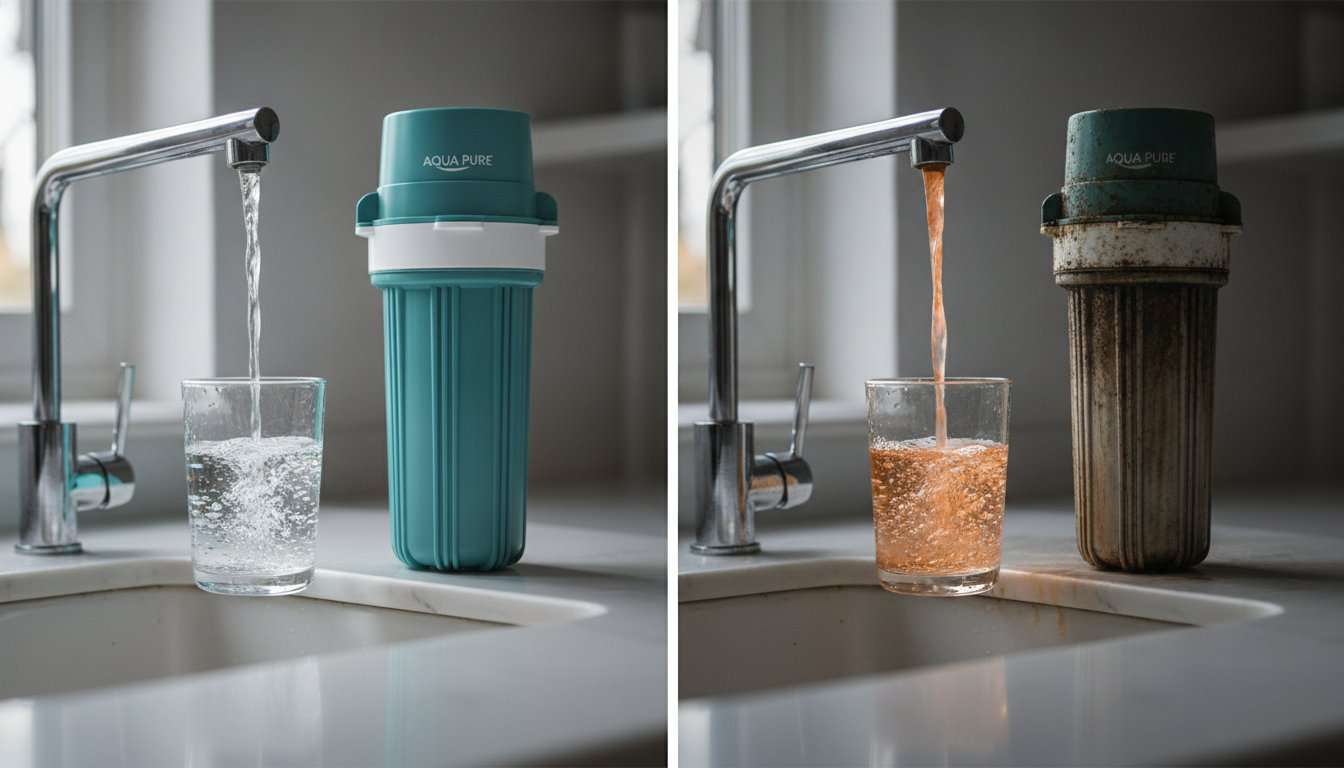
The Invisible Dangers of an Old Water Filter: Why Expired Means Hazardous
What if the very device you trusted to safeguard your family’s health has quietly transformed into a source of contamination? It is a confronting thought, but the scientific reality is that the dangers of old water filter systems are often hidden beneath a surface of apparent clarity. You may feel a sense of uncertainty when faced with conflicting maintenance schedules or simply find it difficult to prioritise a filter change amongst the demands of a busy lifestyle. It’s a common frustration, yet ignoring that expiry date means your filtration system is no longer a barrier; it is a potential breeding ground for the very bacteria and heavy metals you sought to eliminate.
In this article, you’ll discover why an expired cartridge is more than just ineffective; it can actively compromise your drinking water. We will examine the science of biofilm and contaminant breakthrough, providing you with the clarity needed to maintain unrivalled water quality. By understanding these risks, you can ensure your home remains a sanctuary of 99.99% purity, backed by the precision of British engineering that removes the risk of human error and protects your long-term wellbeing.
Key Takeaways
- Understand why visual clarity is a deceptive indicator of safety and how to recognise the hidden dangers of old water filter systems before they compromise your health.
- Learn about the phenomenon of “breakthrough,” where a saturated filter begins to release concentrated doses of the very toxins it originally trapped.
- Discover how an expired cartridge can transform into a breeding ground for bacteria, affecting both your family’s wellbeing and the longevity of your luxury appliances.
- Identify the subtle physical warning signs, from flow rate changes to shifts in water clarity, that signal an immediate need for professional maintenance.
- Explore how bespoke Reverse Osmosis technology offers a level of purity and reliability that standard carbon filters simply cannot achieve.
Myth vs. Reality: Does an Expired Water Filter Still Protect You?
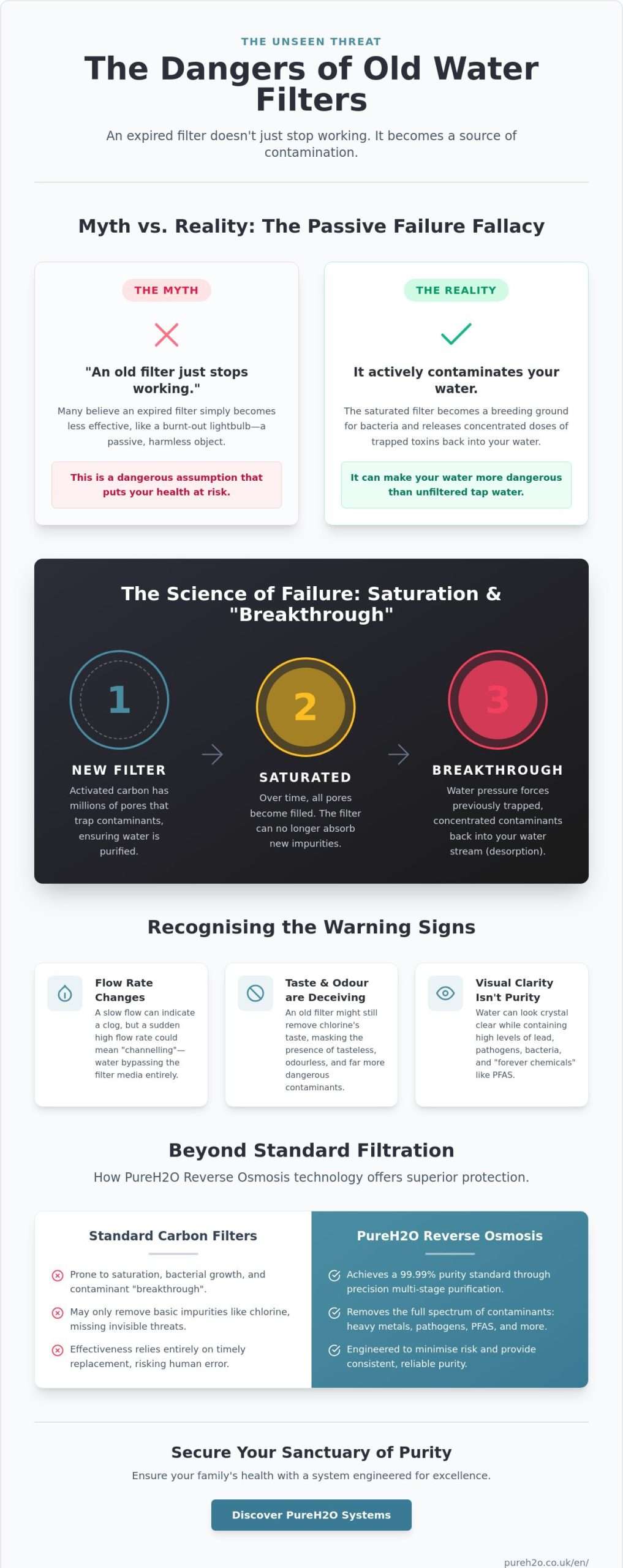
A prevalent misconception amongst homeowners is the belief that a water filter merely loses its efficacy over time, slowly fading into a benign, neutral state. In reality, the dangers of old water filter systems are far more active. A filter does not simply “stop working” like a lightbulb that has flickered out; instead, it reaches a critical threshold where it can no longer safely contain the impurities it has spent months collecting. From a British engineering perspective, longevity is not a suggestion but a definitive safety boundary. We view every component of our purification systems as a precision instrument, designed to maintain a standard of excellence that cannot be compromised by neglect.
To understand this, one must distinguish between various methods of filtration. Whilst mechanical straining physically blocks larger particles, chemical adsorption relies on the finite surface area of activated carbon to trap microscopic toxins. Once this surface area is saturated, the filter can no longer perform its duty. At this point, the device transitions from a protective barrier into a potential source of secondary pollution. This shift risks the health of those who rely on it for their daily hydration, as the accumulated waste begins to seep back into the stream of supposedly purified water.
The Passive Failure Fallacy
Many assume that as long as the water continues to flow freely from the tap, the system is performing as intended. This is a dangerous assumption. In sophisticated home purification systems, a high flow rate can actually be a symptom of “channelling,” where water carves a path through saturated media, bypassing the purification process entirely. Unlike a simple jug filter that might just slow down, a bespoke home system requires meticulous cartridge replacement to prevent the internal environment from becoming a reservoir for the very contaminants you wish to avoid.
Why Taste and Odour Can Be Deceiving
The most insidious dangers of old water filter cartridges are those you cannot perceive with your senses. Pathogens, lead, and “forever chemicals” like PFAS are entirely tasteless and odourless. You might find that your water still tastes crisp and clear, but this is often due to “flavour masking.” Ageing carbon blocks may still remove the sharp scent of chlorine whilst allowing more hazardous, invisible elements to pass through. Relying on your palate to judge water safety is a psychological trap; true purity is only guaranteed by adhering to a rigorous, scientifically-backed maintenance schedule that preserves our 99.99% purity standard.
The Science of Failure: How Saturated Filters Contaminate Your Water
To appreciate the precision of a PureH2O system, one must first understand the finite nature of carbon adsorption. Activated carbon functions through an electrochemical process where contaminants are bonded to microscopic pores. It’s a high-performance mechanism, but it possesses a hard limit. Once every bonding site is occupied, the filter reaches its saturation point. This is where the dangers of old water filter systems become tangible. Rather than acting as a shield, the saturated media begins to act as a concentrated reservoir of every impurity it has ever encountered.
When a filter is saturated, a process called desorption begins. New contaminants entering the system can physically displace those already trapped, pushing them back into your drinking water. This leads to the phenomenon known as breakthrough. Researchers from Duke University and NC State have highlighted the dangers of expired carbon filters, noting that saturated media can actually yield higher toxin levels than tap water. Maintaining your system isn’t just about flow; it’s about biological and chemical integrity. Ensuring you have fresh Replacement Filter Cartridges is the only way to prevent your purifier from becoming a source of the very toxins you wish to avoid.
Chemical Breakthrough Explained
Breakthrough occurs when the concentration of contaminants in the effluent water exceeds the concentration in the influent water. This happens because the chemical bonds between the carbon and the pollutants weaken as more particles compete for space. As pressure fluctuates within the system, these weakly held toxins are forced through the membrane. You are no longer drinking filtered water; you are consuming a concentrated dose of months’ worth of accumulated chemicals, including heavy metals and pesticides that were supposed to be long gone.
The Breeding Ground: Bacteria and Biofilm
The interior of a filter is dark, damp, and, crucially, free of the chlorine that usually keeps microbial growth at bay. Whilst removing chlorine is essential for health and flavour, it leaves the filter housing vulnerable. Over time, bacteria colonise the surface of the media, creating a protective ‘slime’ known as biofilm. This biofilm protects the bacteria from being flushed away by normal water flow. This isn’t just a minor hygiene issue; it can lead to ‘slug loading,’ where large colonies of bacteria are suddenly released into your glass in a single, hazardous dose. Regular maintenance is the only bespoke solution to ensure your water remains at our 99.99% purity standard.
In professional research environments where preventing bacterial growth is even more critical, specialists often find out more about E-commerce sales of bacteriostatic water to maintain the integrity of their laboratory samples.
Health Implications of Microbial Overgrowth
Pathogens thrive in the stagnant, nutrient-rich environment of an expired carbon block. For vulnerable individuals, including children and the elderly, the dangers of old water filter systems are particularly acute as microbial overgrowth poses a significant risk. The CDC emphasises the necessity of regular maintenance to prevent germs from growing in it, as opportunistic bacteria can bypass older membranes with ease. Many low-end systems boast “self-cleaning” features, yet these are rarely sufficient to combat the resilient biofilm that develops over months of use. True safety requires the precision of a PureH2O system, which maintains a 99.99% purity standard only when the filtration media is within its operational lifespan.
Protecting Your Home Infrastructure
The financial implications of filter neglect are often more immediate than many homeowners anticipate. Saturated filters lose their ability to manage mineral content effectively, leading to a sudden surge in “hard water” breakthrough. This allows aggressive limescale to accumulate within the delicate internal mechanisms of high-performance hardware, such as the Quatreau Smart Tap or bespoke boiling water systems. The corrosive impact of unfiltered water can even lead to the “Blue Water” phenomenon, where heavy metals leach from plumbing directly into your glass. Investing in timely Replacement Filter Cartridges is a matter of financial prudence; the cost of descaling or replacing a sophisticated kitchen installation far outweighs the price of proactive maintenance. By adhering to a strict replacement schedule, you ensure that your investment in British engineering remains protected from the abrasive effects of mineral buildup and chemical corrosion, whilst guaranteeing your water remains free from long-term exposure to “forever chemicals” like PFAS.
Recognising the Warning Signs: When to Change Your Filter Cartridge
Whilst the internal mechanisms of a purifier are hidden from view, your system will often provide subtle indicators that it is nearing its operational limit. Relying solely on a calendar date can be misleading, as water quality and consumption volumes vary significantly between households. To mitigate the dangers of old water filter systems, one must adopt a dual approach that combines mechanical vigilance with professional monitoring. Waiting for a warning light on a basic retail sensor is often insufficient; by the time a simple timer alerts you, the chemical integrity of the media may have already been compromised.
Environmental factors also play a critical role in the lifespan of your purification components. For instance, heavy rainfall can increase the turbidity of influent water, causing a filter to reach capacity sooner than expected. Similarly, local utility work can introduce sudden bursts of sediment into the mains. A sophisticated monitoring system accounts for these variables, ensuring that the dangers of old water filter neglect are avoided regardless of external conditions. Adhering to a rigorous maintenance schedule is the only way to guarantee that your water remains a hallmark of refined health.
Sensory and Mechanical Red Flags
A noticeable decrease in water pressure is frequently the first physical sign of a saturated cartridge. As the pores within the media become obstructed by sediment and organic matter, the flow rate diminishes, forcing the system to work harder. You might also detect faint earthy or metallic notes in your water. These sensory changes indicate that the filter is no longer performing its bespoke role of adsorption. Inspecting the cartridge housing for any visible discolouration or sediment buildup is a prudent habit, yet these are late-stage symptoms. Ideally, a replacement should occur before these physical markers manifest to maintain unrivalled purity.
The PureH2O Approach to Monitoring
Simple timers found in standard filters are notoriously inaccurate, as they do not account for the volume of water processed or the specific levels of local contaminants. PureH2O engineering prioritises precision through digital usage tracking and annual servicing by our qualified technicians. This methodical oversight ensures that the 99.99% purity rate we promise remains a constant reality rather than a fluctuating variable. Our experts analyse the environmental factors unique to your location to refine your maintenance schedule. If you are concerned about your current water quality, you can order authentic replacement filter cartridges to restore your system to its peak performance.
Beyond Standard Filtration: How PureH2O Engineering Minimises Risk
Whilst standard carbon jugs and basic under-sink filters offer a rudimentary level of protection, they lack the multi-stage resilience required to eliminate the dangers of old water filter neglect entirely. High-performance water purification is an active process, not a passive one. At PureH2O, our approach to British engineering treats water quality as a measurable metric of health, utilising sophisticated technology that moves beyond simple mechanical straining. By integrating industrial-grade standards into the British home, we ensure that the transition from a protective barrier to a source of contamination is a risk our clients never have to face.
The Quatreau smart tap exemplifies this commitment to safety. Rather than relying on the subjective sensory checks discussed previously, these systems feature integrated maintenance alerts and digital monitoring. This precision engineering removes the burden of guesswork from the homeowner, providing a reliable fail-safe against the dangers of old water filter degradation. It’s a sophisticated, managed solution that aligns with a refined, health-conscious lifestyle, ensuring your home remains a sanctuary of purity whilst contributing to a sustainable, plastic-free future.
The PurityPRO Advantage
The PurityPRO Home Water Purifier distinguishes itself through a multi-stage Reverse Osmosis process that achieves an unrivalled 99.99% purity rate. Unlike standard filters that may succumb to chemical breakthrough, our superior membrane technology provides a definitive barrier against microscopic toxins and heavy metals. To address the “breeding ground” effect common in ageing systems, we incorporate ultraviolet water sterilisation. This stage actively neutralises pathogens, ensuring that even if a cartridge reaches its capacity, the biological integrity of your water remains uncompromised. Our British-made components are engineered for a bespoke fit, preventing the internal bypass and seal failures often found in generic, mass-produced alternatives.
A Bespoke Service for Total Peace of Mind
Maintaining the absolute pinnacle of water quality requires more than just superior hardware; it demands a comprehensive service ecosystem. Our storage tank self-cleaning systems work silently in the background to prevent the stagnation and biofilm development that plagues lesser systems. To ensure your purifier consistently operates at its peak, our national service network provides expert oversight, taking the responsibility of maintenance off your shoulders. This professional care guarantees that every drop from your tap meets our exacting standards for purity and taste. To maintain the integrity of your system and protect your family’s wellbeing, you should ensure your water stays pure with our Replacement Filter Cartridges.
Secure Your Sanctuary of Purity
Understanding the science of filtration reveals that a cartridge is a precision instrument with a finite lifespan. The dangers of old water filter systems aren’t merely about a reduced flow rate; they involve the active release of concentrated toxins and the development of resilient biofilms. Whether enjoying naturally pure, high-pH options like Source Water or adhering to a rigorous maintenance schedule for home filtration, you transform your relationship with water from one of concern to one of absolute confidence.
With over 30 years of purification expertise, PureH2O provides a definitive answer to the complexities of water health. Our British-made engineering ensures that your system remains a reliable barrier against impurities, consistently delivering our hallmark 99.99% purity rate. Choosing an advanced solution means you aren’t just avoiding hazards; you’re embracing a lifestyle defined by refined health and ecological responsibility. It’s an investment in your home’s infrastructure and your family’s long-term wellbeing.
Explore the PurityPRO Home Water Purifier and experience the unrivalled clarity of water perfected by three decades of innovation. Your journey toward a healthier, more sustainable home starts with a commitment to excellence.
Frequently Asked Questions
Can an old water filter make you sick?
Yes, an expired filter can certainly compromise your wellbeing. Over time, the damp, dark interior of the filter housing becomes a breeding ground for bacteria and biofilm, which can lead to gastrointestinal distress. Once the chemical bonding sites are saturated, the filter may even release concentrated doses of trapped toxins back into your glass. Adhering to maintenance schedules is essential to avoid the dangers of old water filter systems and ensure your family’s safety.
How do I know if my water filter has expired?
The most reliable indicator is your system’s digital usage tracker or the manufacturer’s recommended time interval. Physically, you might notice a significant drop in water pressure as sediment clogs the microscopic pores, or a subtle shift in the water’s clarity. Whilst some homeowners rely on their sense of taste, invisible contaminants like lead and PFAS have no flavour, making a rigorous, time-based replacement schedule the only definitive way to maintain unrivalled purity.
What happens if I don’t change my RO membrane on time?
Failing to replace a reverse osmosis membrane on time leads to “TDS creep,” where the purity levels of your water decline sharply. The delicate membrane can become fouled by mineral scaling or degraded by chlorine, which ageing carbon pre-filters can no longer intercept. This not only reduces the quality of your drinking water but can also cause permanent damage to the internal components of your bespoke purification system, leading to costly repairs.
Is it okay to use a water filter after 6 months if I haven’t used it much?
No, it is not advisable to exceed the expiry date even if your water consumption has been low. Once water enters the filter housing, the environment remains damp, which is ideal for microbial colonisation. Pathogens will continue to grow amongst the filter media regardless of whether water is actively flowing through it. Replacing the cartridge every six months is a non-negotiable standard for maintaining our hallmark 99.99% purity guarantee.
Can I clean and reuse an old water filter cartridge?
No, water filter cartridges are precision-engineered for single use and cannot be cleaned or refurbished. Whilst you might rinse away surface sediment, you cannot “reset” the chemical adsorption sites within the activated carbon or the microscopic pores of a reverse osmosis membrane. Attempting to wash a cartridge is entirely ineffective and risks reintroducing concentrated contaminants into your drinking water, undermining the precision of British engineering.
Does an expired filter still remove chlorine and limescale?
An expired filter will largely lose its ability to remove chlorine and manage mineral content effectively. As the carbon block becomes saturated, chlorine passes through freely, which often leads to a noticeable chemical taste and odour. Similarly, the media responsible for sequestering limescale will reach capacity, allowing abrasive minerals to bypass the system and potentially damage your luxury kitchen appliances and bespoke boiling water taps.
What is “breakthrough” in water filtration?
Breakthrough is the critical point where a saturated filter begins to release trapped contaminants back into the effluent water. This occurs when the concentration of toxins in your filtered water actually exceeds the levels found in the original tap water. It represents one of the most significant dangers of old water filter neglect, as it exposes you to a sudden, concentrated dose of heavy metals and chemicals that were previously sequestered within the media.
Why does my filtered water taste metallic after a few months?
A metallic taste often signals that the filter’s adsorption sites are exhausted, allowing minerals and heavy metals to pass through unhindered. In some instances, it may also indicate that the water is leaching metals from your home’s internal plumbing because the filter is no longer balancing the water’s chemistry. If you detect any shift in flavour, it’s a clear mechanical sign that your system requires an immediate cartridge replacement to restore its high-performance standards.
Disclaimer
The content of this article represents the views of the author and 36years practical experience.