

Best Water Softener 2026: The Ultimate Guide to British Water Quality
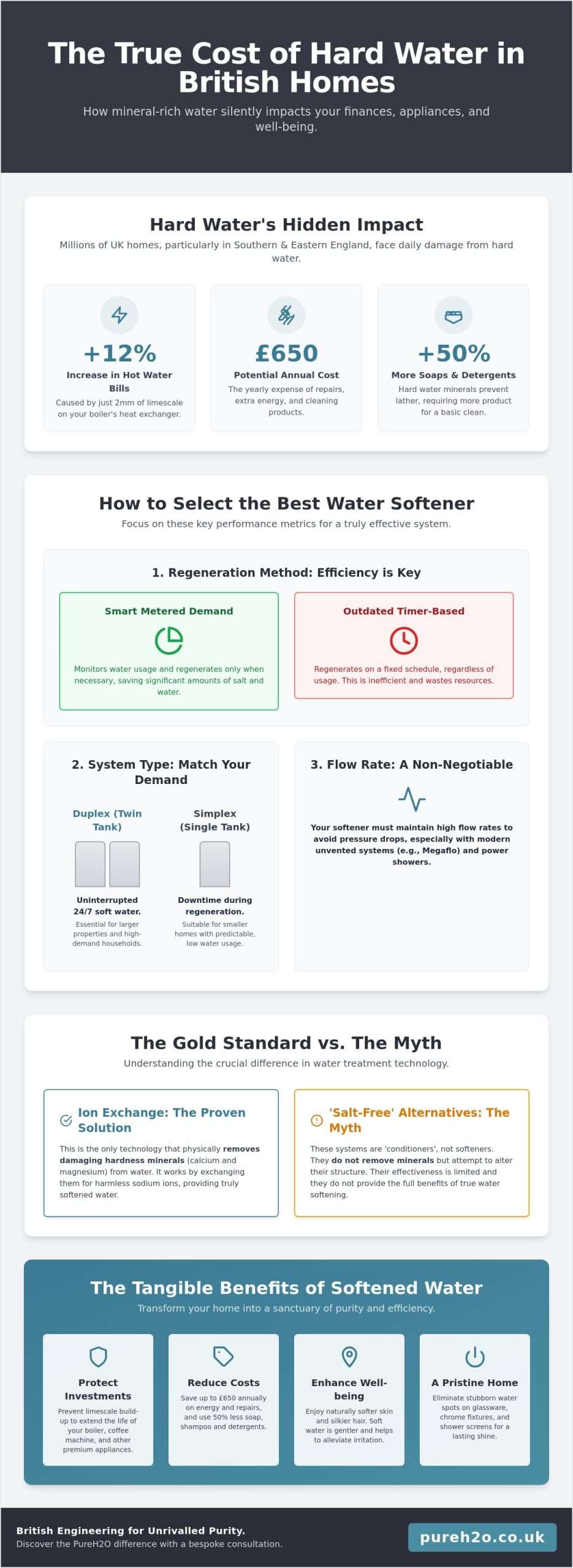
Did you know that just 2mm of limescale on your boiler’s heat exchanger can inflate your hot water bills by 12%? In a sophisticated British home, hard water is more than a minor inconvenience; it’s a persistent tax on your lifestyle and your property’s longevity. You’ve likely grown tired of seeing chalky deposits on your bespoke fixtures or feeling the abrasive effects of mineral-heavy water on your skin and hair. Choosing the best water softener is the essential first step in protecting your investment and restoring the luxury of true purity to your daily routine.
We understand that you demand excellence from your home’s infrastructure. This guide will show you how to select a high-performance system that delivers total protection for your plumbing whilst significantly enhancing your health and wellbeing. We’ll explore the pinnacle of British-engineered technology for 2026, from non-electric efficiency to the latest smart monitoring systems. You’re about to discover how a bespoke approach to water quality can transform your home into a sanctuary of purity and efficiency, underpinned by the technical precision that defines the PureH2O difference.
In this Guide
- Understand why it’s essential to manage mineral levels in Southern and Eastern British regions and how they affect your home’s infrastructure.
- Discover how to select the best water softener by focusing on smart, demand-based regeneration and high flow-rate capabilities.
- Compare the “Gold Standard” of ion exchange against salt-free myths to ensure your system actually removes damaging minerals.
- Learn the technical nuances of installing advanced purification within unvented systems and bespoke cabinetry.
- Explore how PureH2O’s British engineering heritage delivers an unrivalled 99.99% purity rate for a healthier, more sustainable lifestyle.
Understanding the Impact of Hard Water on British Homes
Hard water is a geological reality for millions of households across the United Kingdom. It occurs when rainwater filters through porous rock like limestone and chalk, becoming heavily saturated with dissolved calcium and magnesium carbonate. This mineral concentration is particularly aggressive in the Southern and Eastern regions of England, where the underlying bedrock creates some of the hardest water in Europe. Whilst these minerals aren’t harmful to health, they’re incredibly damaging to the infrastructure of a modern, high-end home.
Limescale: The Silent Destroyer of Luxury Appliances
Premium kitchen technology, such as bespoke steam ovens and integrated coffee systems, relies on intricate internal components that are highly sensitive to mineral deposits. When hard water is heated, the minerals precipitate and form a resilient layer of calcium carbonate. This process, which is the primary reason homeowners seek water softening solutions, chokes heat exchangers and reduces flow rates. Standard descaling treatments are often inadequate for internal pipework, as they don’t address the root cause of the degradation. True protection requires a system that prevents these minerals from ever entering your appliances.
The Aesthetic and Sensory Benefits of Soft Water
The transformation provided by softened water is immediately palpable. In a hard water environment, minerals react with soaps to create a sticky “curd” rather than a rich lather. This means you’ll often use 50% more detergent and shampoo to achieve a basic level of cleanliness. Beyond the cost, these minerals strip the skin of its natural oils, leading to irritation and leaving hair feeling brittle and dull. This focus on gentle cleansing and maintaining natural oils is a principle shared by Essencera, who highlight how specialised care is just as vital for canine skin health. Switching to soft water restores a genuine “spa feel” to your bathing routine. It also ensures that designer chrome and matte black fixtures remain pristine, eliminating the stubborn water spots that usually plague high-end finishes.
Selecting the Best Water Softener: Key Performance Metrics
Selecting the best water softener for a premium British residence requires moving beyond basic retail specifications. It’s a matter of matching sophisticated engineering to the specific hydraulic demands of your property. The most critical distinction lies in the regeneration method. Whilst entry-level models often rely on simple timers, which regenerate regardless of actual water usage, high-performance systems utilise metered demand technology. These systems monitor your consumption in real-time, only initiating a regeneration cycle when the resin capacity is genuinely exhausted. This precision eliminates unnecessary salt and water waste, ensuring your home remains a model of efficiency.
For larger properties, the choice between Simplex and Duplex configurations is paramount. A Simplex system contains a single resin vessel, meaning soft water is unavailable during its regeneration cycle, usually in the early hours of the morning. In contrast, a Duplex system features two vessels that work in tandem. When one requires cleaning, the other immediately takes over, providing an uninterrupted supply of softened water 24 hours a day. This is essential for households that prioritise convenience and consistency across multiple bathrooms.
Flow rates are another non-negotiable metric. Many standard softeners struggle with the high-pressure requirements of modern unvented systems, such as Megaflo cylinders, or high-demand power showers. A drop in pressure is often the result of using inferior internal components or narrow-bore valving. PureH2O prioritises high-grade polymers and robust internal architecture to maintain unrivalled flow rates across every tap in your home. You can explore our range of bespoke water softeners to see how these technical standards are applied to protect your home’s infrastructure.
Efficiency and Sustainability in 2026
Modern water engineering has made significant strides in salt optimisation. Advanced sensors now calculate the exact amount of brine needed for each cycle, preventing the environmental impact of excess sodium discharge. By removing the minerals that hinder soap performance, these systems also allow you to reduce detergent and chemical cleaner usage by up to 50%. This creates a cleaner, more sustainable future for your household whilst maintaining the luxury standards you expect.
Sizing the System for Your Household
Precision sizing is about more than just volume; it’s about the chemistry of your specific supply. Calculating the “grains of hardness” against your daily water usage ensures the resin bed isn’t undersized, which leads to premature wear, or oversized, which risks bacterial stagnation during periods of low use. Professional engineering ensures your system is future-proofed for guest visits or household expansion without compromising water purity or system longevity.
Comparing Technologies: Ion Exchange vs. Salt-Free Alternatives
The market for domestic water treatment is often clouded by conflicting marketing claims, particularly regarding “salt-free” technology. To select the best water softener for your home, it’s vital to distinguish between true water softening and simple water conditioning. Whilst both aim to mitigate the effects of hard water, their scientific methods and tangible results differ profoundly. True softening requires the physical removal of calcium and magnesium ions from the supply, a process that only ion exchange technology can reliably achieve.
Many homeowners are drawn to salt-free alternatives due to the promise of lower maintenance. However, these systems, often utilising Template Assisted Crystallisation (TAC), do not remove minerals. Instead, they attempt to alter the chemical structure of the minerals to prevent them from adhering to surfaces. Whilst this may offer some protection for moving water, it fails to provide the comprehensive purity that a high-performance British home requires. For total appliance protection and the elimination of limescale, ion exchange remains the undisputed gold standard.
The Science of Ion Exchange
At the heart of a premium ion exchange system are high-capacity resin beads, which are chemically charged with sodium ions. As hard water passes through the resin bed, a scientific “swap” occurs: the resin captures the calcium and magnesium ions and releases a negligible amount of sodium in their place. This process is supported by a brine tank, which uses high-purity salt pellets to periodically regenerate the resin beads and maintain system efficacy. Ion exchange is the only proven method for the total removal of hardness minerals from a domestic water supply.
Why Salt-Free Conditioners Often Fail in the UK
Salt-free conditioners often struggle with the high flow rates and specific plumbing configurations found in modern British residences. Because these systems only “condition” the water, minerals remain present in the supply. When water sits stationary, such as in a kettle or a designer coffee machine, the conditioning effect often breaks down, leading to the same chalky deposits you were seeking to avoid. Furthermore, whilst resin in an ion exchange system can last for over a decade with proper care, salt-free systems frequently require expensive cartridge replacements to maintain even basic performance levels.
Magnetic and electronic descalers represent another category of “physical conditioners.” Whilst these devices are often marketed as effortless solutions, their scientific reality rarely matches the needs of a high-demand household. They offer no measurable reduction in water hardness and provide inconsistent protection for internal pipework. PureH2O advocates for the precision of ion exchange because it’s the only technology that guarantees the 99.99% purity levels required for a truly luxury water experience. By physically extracting the cause of the problem, you ensure your home’s infrastructure remains pristine for the long term.
Bespoke Installation and Smart Integration
Installing the best water softener is not a simple plumbing task; it’s a precision engineering exercise. Whilst retail guides often suggest DIY installation, the reality of modern British plumbing is far more complex. High-end residences frequently utilise unvented systems, such as Megaflo cylinders, which operate under significant pressure. Integrating a softener into these environments requires a deep understanding of hydraulic balancing to ensure that your property’s safety and performance standards aren’t compromised. It’s about precision. Our engineers focus on maintaining the integrity of your home’s infrastructure whilst delivering the soft water your lifestyle demands.
Spatial planning is another critical factor that separates a standard installation from a bespoke one. In a premium kitchen or utility room, cabinetry is often designed to exacting standards with little room for error. We specialise in integrating high-performance systems into these restricted spaces, ensuring that the equipment is accessible for salt replenishment without disrupting the aesthetic flow of your home. This level of detail extends to the “drinking water gap.” Because softened water contains slightly elevated sodium levels, we ensure your system includes a dedicated hard-water bypass or, for the ultimate experience, a secondary purification stage for consumption.
Smart home connectivity has become a hallmark of the modern household in 2026. The most advanced systems now feature integrated sensors that monitor salt levels and water usage in real-time. These insights are delivered directly to your mobile device, providing early leak detection and ensuring you never run out of consumables. This proactive approach to maintenance provides peace of mind, knowing that your home is protected by the latest in water technology.
Integrating with the PurityPRO and Quatreau Systems
A water softener serves as the essential foundation for a wider water health ecosystem. By removing the harsh minerals that can foul delicate membranes, a softener acts as the perfect pre-filter for our PurityPRO Reverse Osmosis systems. This synergy is particularly vital for the longevity of your Quatreau Smart Tap. By providing an ideal water feed, you protect the intricate boiling and cooling components of your tap, ensuring it delivers unrivalled performance for years to come. It’s the difference between simple filtration and a comprehensive 99.99% purity strategy.
The Importance of Post-Installation Support
Our commitment to your water quality doesn’t end with the installation. To maintain the PureH2O difference, we recommend annual service intervals where our engineers conduct a comprehensive check-up of your system’s performance. We manage the complexities of consumable replenishment, from high-purity salt deliveries to filter cartridge changes, so you don’t have to. With a national service network at your disposal, you can enjoy the luxury of soft water with absolute confidence in its long-term reliability. If you are ready to elevate your home’s water quality, contact our engineering team to discuss a bespoke solution.
The PureH2O Difference: Elevating British Water Engineering
Since 1991, PureH2O has been a pioneer in high-end water treatment, rooted in a proud heritage of British engineering. Whilst many providers offer off-the-shelf solutions, we believe the best water softener is one that’s meticulously tailored to the specific mineral profile of your postcode. Our legacy of innovation isn’t just about longevity; it’s about a relentless commitment to technical excellence and environmental responsibility. We don’t just aim to remove calcium; we strive for a 99.99% purity goal that addresses the total health of your home’s water supply, ensuring that every drop meets the absolute pinnacle of purification standards.
Choosing a PureH2O system means investing in a bespoke piece of equipment designed to outlast and outperform standard retail units. We utilise food-grade materials and high-capacity resins that maintain their efficacy over decades, not just years. Our no-compromise approach ensures that your water pressure remains consistent across every floor of your residence, a factor that leads many of the UK’s leading architects and developers to specify PureH2O for their most prestigious projects. This level of professional endorsement is a testament to the reliability and precision we bring to every installation.
Why PureH2O Systems Outperform Standard Retail Units
Standard units often rely on lower-grade plastics and generic resin beds that struggle with the aggressive mineral levels found in certain British regions. In contrast, PureH2O systems are engineered to handle high-demand environments without a drop in performance. By prioritising flow consistency and using superior components, we ensure your luxury appliances and plumbing systems are protected by the most advanced technology available. This dedication to quality is why our systems remain the preferred choice for those who value both aesthetics and engineering integrity.
Your Journey to Pure Water
The path to unrivalled water quality begins with a detailed on-site analysis of your home’s current supply. Our technical experts examine the unique chemical composition of your water to create a bespoke system design that meets your specific requirements. Once the design is finalised, our expert team carries out a seamless installation, ensuring your new system integrates perfectly with your existing infrastructure. This methodical approach ensures that from the first turn of the tap, you’re experiencing water in its most refined and healthy form.
Experience the PureH2O Difference – Book a Consultation
Secure the Future of Your Home’s Water Quality
Hard water is an avoidable burden on your property’s infrastructure and your daily wellbeing. The distinction between simple conditioning and true mineral removal is the key to protecting your investment. By selecting a system rooted in ion-exchange technology, you ensure that your luxury appliances, designer fixtures, and plumbing remain free from the silent degradation of limescale. It’s about more than just maintenance; it’s about preserving the aesthetic and functional integrity of your home. For homeowners seeking reliable support with wider building alterations or ongoing upkeep, click here to explore comprehensive property maintenance and refurbishment services.
The best water softener for a sophisticated British residence is one that respects the complexity of modern unvented plumbing whilst delivering uncompromising flow rates. Since 1991, our British-made engineering has provided the foundation for a healthier, more sustainable lifestyle. When our softeners are integrated with a PurityPRO system, we achieve a 99.99% purity rate that standard filtration simply cannot match. Our specialist installers are ready to help you transition to a home defined by technical precision and the quiet confidence of superior water quality.
Explore our range of bespoke Water Softeners
Frequently Asked Questions
Is it safe to drink softened water in the UK?
Softened water is safe for the majority of the population, provided the sodium levels remain below the regulatory limit of 200 mg/l. However, it’s not recommended for preparing infant formula or for individuals on a medically prescribed low-sodium diet. Most high-end installations include a dedicated bypass or a secondary purification system to ensure your drinking water meets the highest health standards without the added sodium from the softening process.
How much salt does a high-efficiency water softener use annually?
Salt consumption depends on your household’s water volume and the specific hardness of your local supply. A high-performance, metered system typically requires between 100kg and 150kg of salt per year for an average family of four. To help manage these requirements, find out more about Direct-to-consumer e-commerce sales of water treatment hardware and maintenance supplies to ensure you have the correct materials for your system. Because these systems only regenerate when the resin is exhausted, they’re significantly more efficient than older timed models, preventing unnecessary waste and reducing your environmental impact.
Can I install a water softener with a combi boiler or Megaflo system?
Yes, you can install a system with these configurations, but it requires technical precision. To maintain the performance of unvented systems like Megaflo, you must select the best water softener with high-flow capabilities and robust internal valves. Professional engineering is essential here to ensure that your water pressure remains consistent across all luxury fixtures whilst protecting the delicate heat exchangers within your combi boiler.
Do water softeners remove fluoride or chlorine from the water?
No, ion exchange technology is designed solely to remove dissolved minerals like calcium and magnesium. It doesn’t have the chemical capacity to filter out fluoride, chlorine, or microplastics. To achieve comprehensive water health and our hallmark 99.99% purity rate, we recommend integrating your softener with a PurityPRO reverse osmosis system, which addresses the chemical and microbiological contaminants that softening leaves behind.
What is the difference between a water softener and a water conditioner?
A water softener physically extracts hardness minerals from the water through a scientific process called ion exchange. In contrast, a conditioner merely treats the water to discourage scale from sticking to surfaces, whilst the minerals themselves remain present. Only a true softener provides the tactile “spa feel” and the total elimination of limescale, making it the superior choice for protecting bespoke home infrastructure.
How long does a premium water softener typically last?
A bespoke system built with high-grade polymers and food-grade resins typically has an operational lifespan of 15 to 20 years. This longevity is a direct result of superior British engineering and regular maintenance. By scheduling annual service intervals, you ensure that the internal components and smart sensors continue to function with the same precision they possessed on the day of installation.
Will a water softener help with skin conditions like eczema or psoriasis?
Softened water is frequently cited as a significant aid for those with sensitive skin conditions. By removing the minerals that react with soaps to form an irritating “curd,” soft water allows your skin’s natural oils to remain intact. This prevents the abrasive residue and dryness that often trigger flare-ups of eczema or psoriasis, restoring the skin’s barrier function and improving overall dermatological health.
Do I need a separate tap for drinking water if I have a softener?
The British Water Code of Practice recommends that at least one tap in the home remains unsoftened for drinking and food preparation. This ensures that your sodium intake remains within recommended levels. Our Quatreau Smart Tap range offers a sophisticated way to comply with this guidance, providing a dedicated feed of purified water whilst the rest of your home enjoys the benefits of a softened supply.
Disclaimer
The content of this article represents the views of the author and 36years practical experience.